

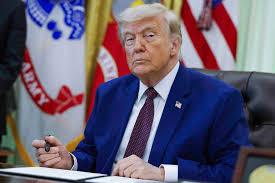
In a landmark decision on Friday, June 5, a federal judge struck down a series of immigration policies implemented by President Donald Trump’s administration, ruling them unlawful and ordering their immediate reversal.
Chief U.S. District Judge John McConnell of Providence, Rhode Island, issued a sweeping 135-page ruling declaring that U.S. Citizenship and Immigration Services (USCIS) had unlawfully imposed immigration restrictions targeting citizens from 39 countries across Africa, Asia, Latin America, and the Middle East.
The expanded restrictions were introduced following a shooting incident in Washington, D.C., during Thanksgiving week last year, in which two National Guard members were shot. The suspect was an Afghan national who entered the United States in September 2021 and was granted asylum in April 2025. One service member was killed and another seriously injured in the attack.
In response, the Trump administration expanded an existing travel ban from 19 countries to 39. Newly added countries facing full restrictions included Laos, Sierra Leone, Burkina Faso, Mali, Niger, South Sudan, and Syria. Partial restrictions were imposed on an additional 15 nations, including Nigeria, Senegal, Tanzania, The Gambia, Mauritania, Angola, Gabon, Zambia, and Zimbabwe, among others.
The White House argued that the affected countries had failed to meet U.S. security screening and information-sharing standards. Restrictions were also imposed on travel documents issued by the Palestinian Authority.
Under the policy, USCIS halted processing of asylum applications, work permits, green cards, and citizenship applications for nationals of the 39 targeted countries. The agency also suspended asylum processing for applicants from all countries worldwide and ordered a review of immigration benefits previously granted to individuals from the listed nations during the Biden administration.
Thousands of naturalization ceremonies were abruptly cancelled, leaving immigrants who had spent years navigating the legal process suddenly facing uncertainty just steps away from becoming U.S. citizens.
A coalition of immigrant advocacy organizations and labor unions filed suit in March, arguing that the administration had imposed the restrictions through executive action without legal authority and in direct violation of federal immigration law enacted by Congress.
After months of hearings, Judge McConnell ruled in favor of the plaintiffs.
In his decision, McConnell wrote that the policies had placed countless immigrants into indefinite legal limbo. He emphasized that many affected individuals had done nothing wrong and were being penalized solely because of their country of origin.
The judge noted that immigration debates often emphasize that people should come to America through legal channels. According to McConnell,the plaintiffs in this case had done exactly that, while the government agency responsible for administering the law had failed to follow it.
“The rule of law must apply equally to everyone,” McConnell wrote. “Here, USCIS did not follow the law or act through proper legal channels. Instead, the agency violated the very immigration laws Congress charged it with administering.”
The ruling requires the Trump administration to immediately resume processing green card applications, asylum requests, employment authorization documents, and naturalization applications for citizens of the affected countries.
For many immigrants living legally in the United States on time-limited visas, the processing freeze had created fears that their legal status could expire before their applications were reviewed.
The decision is being hailed as a major victory for immigrants and their advocates. It also means that thousands of canceled citizenship ceremonies must now be rescheduled.
Immigration advocates quickly welcomed the ruling.
Sean VanDiver, president of AfghanEvac, an organization that assists Afghan refugees in the United States, said his group had spent months hearing from Afghan allies whose citizenship ceremonies were canceled, whose work permits expired, and whose green card applications remained stalled despite complying with every legal requirement.
He described the decision as a victory for the rule of law and for thousands of immigrants who followed the legal immigration process only to find themselves trapped in bureaucratic uncertainty.
Legal experts expect the Trump administration to appeal the ruling. The Department of Homeland Security had not publicly commented on the decision as of Friday evening.
Analysts say the ruling represents another significant legal setback for the administration’s efforts to tighten immigration controls. They also caution against conflating immigration with national security concerns, noting that numerous studies have consistently found that immigrants have lower rates of crime and incarceration than native-born Americans.
The case is expected to have far-reaching implications for U.S. immigration policy and could become one of the most closely watched legal battles of Trump’s second term.