

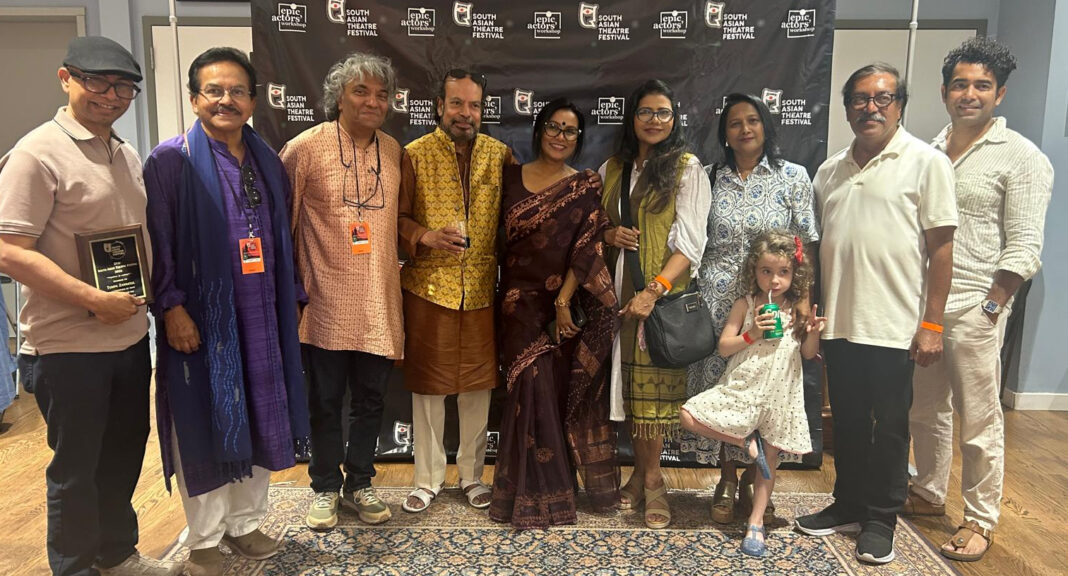
The curtain fell on the 21st South Asian Theatre Festival on Sunday, June 21, concluding two weekends of vibrant theatrical performances, artistic dialogue, and cultural exchange in New Jersey. Running from June 13–14 and June 20–21, this year’s festival was presented in partnership with CoLab Arts, marking a significant new chapter in the festival’s two-decade history.
For the first time, the festival was hosted at CoLab Arts’ newly built Community Auditorium, after many successful years at the New Brunswick Performing Arts Center (NBPAC). While the new venue offered a more intimate atmosphere, it also brought logistical changes. Unlike previous editions, which were held over three consecutive days in a 300-seat theatre, the CoLab auditorium accommodates only 110 to 120 audience members. To maximize accessibility, several productions were presented twice—either on the same day or across two days—allowing theatregoers multiple opportunities to experience the performances.
The venue, however, was not without challenges. Parking emerged as the most common complaint among attendees, with many forced to park several blocks away and pay additional fees, drawing comparisons to the parking difficulties often associated with Manhattan.
Opening the festival, founder and artistic director Dipan Roy spoke about the evolving role of theatre in contemporary society. He highlighted a groundbreaking collaboration among Overlook Hospital, the New Jersey Theatre Alliance, Epic Actors’ Workshop, and Vivid Stage Theatre, describing it as an example of how theatre can intersect with healthcare and community well-being.
“Theatre today is moving in new directions,” Roy said. “It is no longer only about entertainment—it has become a powerful tool for healing, dialogue, and human connection.”
The festival welcomed distinguished theatre artists Meghnad Bhattacharya and Avanti Chakraborty from Kolkata. Chakraborty, a Special Fellow in Directing from the Yale School of Drama, brought an international perspective to this year’s programming. Veteran Bangladeshi playwright Mamunur Rashid had been scheduled to attend but was ultimately unable to travel.
The festival opened on June 13 with CoLab Arts’ English-language production Heat Burst, followed by Atmajan, written by Ujjwal Chattopadhyay and directed by Meghnad Bhattacharya, presented by Spotlight Columbus.
On June 14, audiences experienced one of the festival’s most visually ambitious productions, Whispers of a Banyan Tree, created by Sahitya Akademi Award-winning playwright and director Mahesh Dattani. Inspired by Indian folklore, the multilingual production featured a twelve-member ensemble whose choreography, music, lighting, and poetic storytelling transported audiences into a world of timeless legends and childhood imagination.
While widely admired for its artistic richness, several audience members observed that the production—originally designed for a much larger stage—lost some of its visual impact within the smaller performance space.
One of the festival’s most thought-provoking productions followed with Amanush (The Inhuman), the acclaimed psychological drama by renowned Bangladeshi playwright Mamunur Rashid. Directed by Jannatul Tumpa in her first full-length stage production, the play explored trauma, memory, war, and the fragile boundaries between sanity and madness.
Built around only two characters—a husband and wife—the drama follows a former schoolteacher haunted by guilt, convinced he has murdered his own teacher. Trapped between memories of Bangladesh’s Liberation War and the realities of the present, he struggles to distinguish past from present while confronting the violence that exists within individuals and society.
The play leaves the source of the protagonist’s psychological trauma deliberately ambiguous. His references to the nine months of war, the murder of his family, the humiliation of teachers, and the horrors of Hiroshima and Nagasaki combine to create a haunting meditation on violence, memory, and human nature. Rashid’s fluid use of time and space allows history and contemporary reality to merge into a single psychological landscape.
Hira Chowdhury delivered an emotionally powerful performance in the leading role, convincingly portraying a man overwhelmed by grief, rage, and psychological collapse. His wife, Mitali Das offered a restrained yet deeply moving portrayal of love, fear, and helplessness. Significantly, neither character is given a name, reinforcing the playwright’s intention to make them universal rather than confined to a particular identity or place.
The production featured effective music and sound design, although the lighting design could have been more refined in certain scenes. Despite being her directorial debut, Jannatul Tumpa demonstrated confidence and artistic sensitivity. A slightly tighter pace and more psychologically motivated physical movement for the lead character might have strengthened the production further, but Amanush was nonetheless warmly received by audiences.
Between the major productions, director Subhashish presented the experimental piece Life in Theatre, featuring young performers. The work offered audiences a refreshing and contemporary exploration of theatre through the eyes of a new generation.
The festival continued during the second weekend with several noteworthy productions. Among them was Indur Kol, written by Asit Ghosh and presented by the BCS Theatre Group of South Jersey under the direction of Banerjee.
Another highlight was Crossing to Talikota by legendary Indian playwright Girish Karnad, presented in English by ICS Theatre and directed by Anand Rao. Based on the historic Battle of Talikota in 1565—which led to the fall of the Vijayanagara Empire—the large-scale historical drama featured elaborate costumes, a substantial cast, and powerful battle sequences. Although lengthy, the production successfully maintained audience engagement throughout.
The festival concluded with one of its most intellectually ambitious productions: Medea’s Sister (Human Fate): Greek Tragedy Lab #3, presented by Epic Actors’ Workshop. Directed by Avanti Chakraborty and written by Arnab Banerjee, the English-language production reimagined three iconic women from Greek tragedy—Medea, Antigone, and Clytemnestra.
Rather than portraying these women as history traditionally has—as villains, silent victims, or marginalized figures—the production challenged those narratives, presenting them as complex individuals confronting power, injustice, and patriarchy. The production raised profound ethical, political, and emotional questions while inviting audiences to reconsider the stories history has told about these women.
The stage design, inspired by the eerie atmosphere of Shakespeare’s Macbeth and its three witches, created a striking visual language that complemented the gradual emotional evolution of the female protagonists.
Outstanding performances came from Gargi Mukherjee as Medea, Puja Souri as Antigone, and Prabha Agarwal as Clytemnestra. While the performances by the male actors appeared comparatively subdued, the production as a whole stood out for its artistic sophistication. The creative team included Birsa Chatterjee (music), Abhijit Niyogi (lighting), Uttam De (set design), and Amiya Mehta (production manager).
Throughout the festival, Life in Theatre continued to engage audiences with its experimental approach, reinforcing the festival’s commitment to nurturing emerging voices.
For more than twenty years, Dipan Roy has transformed the South Asian Theatre Festival into far more than an annual theatrical event. Under his leadership, it has become a platform for artistic collaboration across South Asia, bringing together theatre groups from diverse cultural traditions while ensuring that Bangladeshi theatre maintains a prominent place within the festival. Bangladeshi theatre practitioners Golam Sarwar Harun and Faruk Azam currently serve on the festival’s core committee.
Looking ahead, Roy envisions expanding the theatre’s social impact even further. Among his future initiatives is a project that will transform the lived experiences of nurses, patients, and healthcare professionals into theatrical works, reflecting his belief that theatre should remain deeply connected to contemporary human experience.
His broader mission extends beyond serving the South Asian diaspora. Roy continues to build bridges between Bengali theatre and mainstream American theatre institutions, introducing wider audiences to the richness and diversity of South Asian dramatic literature.
The festival concluded with closing remarks by Amitabh Cheli, who thanked the performers, directors, volunteers, donors, sponsors, and audiences whose support made the event possible. A community dinner followed, bringing participants together in celebration of another successful festival.
After four days of performances spanning two weekends, the 21st South Asian Theatre Festival once again demonstrated that South Asian theatre in North America is not merely preserving cultural traditions—it is continually evolving, embracing new ideas, fostering collaboration, and creating meaningful artistic conversations that resonate far beyond the stage.

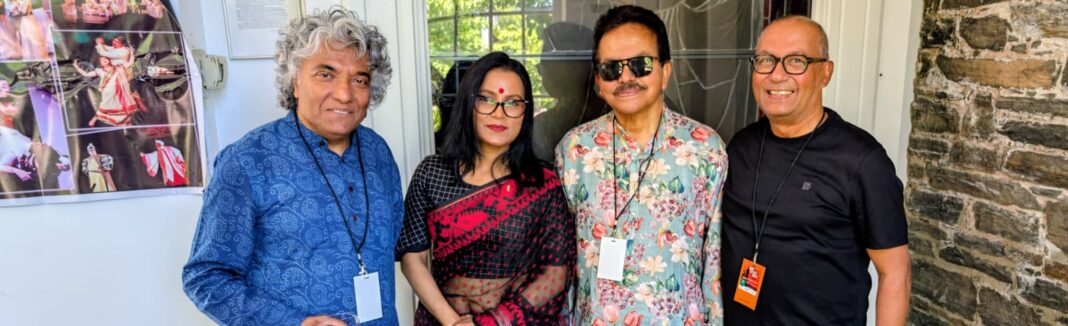


From the 6, Harinath Dey Road, Mymensing to the New Jersey, Roy’s Life is a wonderful journey.