
Brick Lane in London. The lampposts are painted red and green. Bengali letters, shop signs, and the hum of people line both sides of the street. Somewhere you hear a Sylheti accent; somewhere else, London English; and sometimes an unusual blend of the two. I am standing on Brick Lane, yet my eyes keep wandering across the Atlantic—to Brooklyn, New York. Church and McDonald Avenues. Jamaica in Queens. Jackson Heights. Parkchester in the Bronx. These names follow me.
Brooklyn was one of the earliest homes of New York’s Bangladeshi community, along with Sixth Street in Manhattan. The stories of our indomitable immigrants, who traveled thousands of miles, are hidden in the corners of these neighborhoods. Sometimes on the shutters of shops, sometimes on the staircases of old apartment buildings, and sometimes in the eyes of an elderly person.
Brick Lane and Brooklyn—two addresses standing on opposite sides of two oceans. Two street corners. And yet both seem to say the same thing: We came. We stayed. And this city is ours, too. But the beginnings of the two stories were not the same. Their endings may not be either.
Brick Lane’s story is much older. For more than seventy years, Bangladeshi immigrants have made their homes here. Curry houses, fish shops, sweet shops, clothing stores—all emerged over time. But even before that came the story of the sea. South Asian lascars who worked aboard ships of the British Empire had landed along the Thames long before. Their footprints were quiet. There were no red-and-green lampposts. No Bengali shop signs.
Then came the 1960s. People from the greater Sylhet region began arriving in London—in search of work, at the invitation of relatives, driven by the hope of a better future. Many found employment in textile factories in East London. As the labor market in Jewish-owned factories changed and earlier residents gradually moved to other parts of the city, the homes they left behind were occupied by people from Sylhet.
One immigrant family moved into a home once occupied by another immigrant family.
History sometimes changes homes in precisely this way. In 1976, a building whose past had included a church and later a synagogue became the London Jamme Masjid. Within the walls of a single building were traces of three immigrant chapters belonging to three faiths.
One building. Three religions. Three generations of immigration. There are not many stories like this in the history of the world.
The wave that transformed Brick Lane into what it is today came later. And that wave was not simply economic—it was also a struggle for survival.
May 4, 1978. Altab Ali was returning home after work. Near St Mary’s Park, he was stabbed to death. He was only twenty-four. He had come to London from Bangladesh in 1969 and worked in the garment industry. Ten days later, on May 14, thousands of Bengalis walked behind his coffin through Hyde Park toward Downing Street. The coffin of a young garment worker was no longer merely the coffin of one man. It became a declaration of a community’s fear, anger, and existence.
We are here.
We will remain here.
In 1998, the park was renamed Altab Ali Park. A park in London was named after a Bengali man—not a politician, not a billionaire, but a garment worker. What greater memorial could there be to the history of immigration?
New York’s ordeal came in a different form.
After the Twin Towers fell on September 11, 2001, the skies over New York were not the only things filled with smoke. A shadow of suspicion also fell over the identities of many people. Special registration, surveillance, detention, and the fear of deportation faced by Muslim and South Asian immigrants remain an uncomfortable chapter in the memories of many families.
The fear on Brick Lane was often visible on the streets. In New York, the fear was sometimes invisible—a file, a list, the possibility of a knock on the door. The face of the struggle was different. But the smell of fear was the same.
And still, people endure.
The backbone of Brick Lane’s economy eventually became a kitchen. Factories closed. Unemployment rose. People opened their own restaurants. The kitchen became a source of employment, dignity, and a ladder toward the future for immigrants.
Today, a large number of Britain’s so-called “Indian” restaurants are owned by people of Bangladeshi origin. The name remained “Indian” because when many of these restaurants were being established, Bangladesh was still a newly independent country, and “Bangladeshi food” had not yet developed a distinct identity in the global food market.
Cooking with your own hands and serving it under someone else’s name—what could be a more perfect metaphor for immigration?
In New York, the backbone was different. A steering wheel. A shop cash register. A yellow taxi. Grocery stores. Newsstands. Then real estate, home care, pharmacies, and countless small businesses.
Nearly forty years ago, Shahid Ullah and the late Abdul Kashem opened Asian Oriental Grocery in Kensington, Brooklyn. It became a small but important refuge for a rapidly growing Bangladeshi community, offering halal meat, local vegetables, spices, and other familiar necessities.
One shop. Then a neighborhood.
That is how immigrants build cities.
By numbers, both communities are large today. But there are stories within the numbers. Official statistics tell us only so much; the actual community may be considerably larger. Undocumented people, families left outside official counts, and changes across generations are not always captured in government figures. Still, for a journalist, verifiable official statistics remain the safest ground.
At a gathering in East London, veteran journalist Nahas Pasha once asked where the Bangladeshi immigrant communities that had grown on opposite sides of the world stood in comparison in their journey forward.
It is not an easy question.
At community gatherings, there is rarely enough time to discuss such questions at length. One must speak within a time limit, and one must listen as well. Yet that question stayed with me.
Because when Brick Lane and Brooklyn are placed side by side, we do not simply get the stories of two cities. We see two different trajectories of Bangladeshi migration.
In Britain, political representation became visible relatively earlier. In 2010, Rushanara Ali became the first British Bangladeshi elected to the British Parliament. In the 2024 election, four women of Bangladeshi heritage—Tulip Siddiq, Rushanara Ali, Rupa Huq, and Apsana Begum—were elected to Parliament.
The concentration of Bangladeshis in Tower Hamlets is also significant. In East London politics, a new generation of political participation has emerged, including councillors, mayors, and speakers of Bangladeshi heritage. Lutfur Rahman is not simply the mayor of Tower Hamlets, nor is Mostaq Ahmed simply a speaker. They are visible milestones in the long journey of an immigrant community.
In America, the clock may have started moving a little later. But it never stopped.
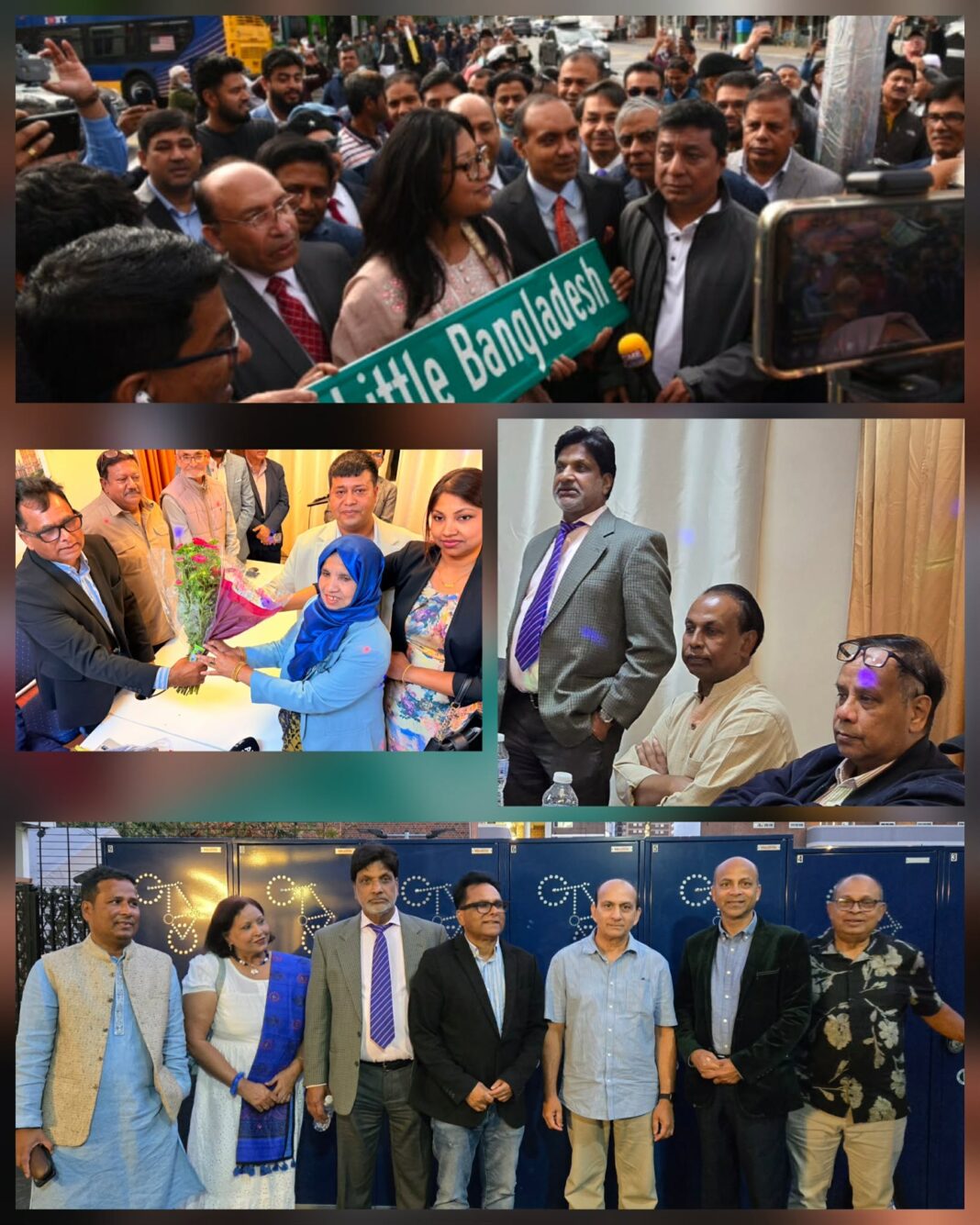
In 2021, Shahana Hanif, who grew up in Kensington, Brooklyn, was elected to the New York City Council. She became the first Muslim woman and first Bangladeshi-American council member. On October 16, 2022, through her initiative, the intersection of Church Avenue and McDonald Avenue was designated “Little Bangladesh.”
A sign was installed that day. But it did not simply name a street.
It inscribed decades of immigration history.
People who came from different parts of Bangladesh, including Sandwip, Noakhali, and Chittagong, crossed difficult distances and confronted even more difficult realities after arriving in Brooklyn. The name became a recognition of that struggle.
And then there is language.
In a multilingual city like New York, Bengali is now among the languages used on official election ballots. The person who may once have opened a lottery envelope with trembling hands, or who was afraid to fill out a government form in English, now sees their language as a visible part of civic life in the city.
In London, it is even more visible. Bengali appears at stations in East London. Bengali in shops. Bengali in restaurants. Bengali in politics. Inside homes, the Sylheti language has survived across generations.
The global spread of Bangla did not happen overnight. Behind it are the people who arrived with battered suitcases, worked night shifts, drove taxis, stood in restaurant kitchens, opened shops, endured insults, experienced fear—and went back to work the next morning.
But the futures of the two stories are now slowly beginning to diverge.
Brick Lane is, in a sense, becoming a victim of its own success. Rents have risen. Gentrification is changing the face of the old neighborhood. One by one, many curry houses are closing. The younger generation does not necessarily want to stand in their fathers’ restaurants. They want to become doctors, barristers, university graduates, members of Parliament.
That is progress.
But there is a certain sadness within progress as well. The place that taught you how to stand may, after you have risen, one day have no work left for you.
Perhaps that is the cruelest joke of upward mobility.
New York has not yet reached that turning point completely. New shops are still opening. Buildings are being purchased. New neighborhoods are taking shape. From Queens to the Bronx, from Ozone Park to Long Island, the map of Bangladeshi presence is changing a little every day.
New people are arriving, too.
With new dreams.
Brick Lane’s experience, therefore, is not merely history for New York. Perhaps it is a mirror.
Because the real test of a community does not come with the first generation. The first generation survives through struggle. The second lives through establishment.
The question facing the third generation is different:
Will they remember where they came from?
What happens when children no longer speak Bengali? When Bengali letters disappear from shop signs? When an old restaurant is replaced by a new brand?
Will the name “Bangladesh” remain merely on a sign—or will it remain in people’s memories?
Brick Lane to Brooklyn—the distance is roughly 3,500 miles. But the distance cannot really be measured in miles.
At one end stands a red-and-green lamppost. At the other, a green sign bearing the words “Little Bangladesh.”
Standing at those two corners of two cities, it feels as though our people did not simply come to these cities. They built a place for themselves within them.
At first, there was a home.
Then a shop.
Then a mosque.
A restaurant.
A taxi.
A vote.
A street name.
A seat in Parliament.
This is how immigrant history eventually becomes city history.
Our first-generation immigrants arrived with almost nothing. An unfamiliar language. An unfamiliar climate. Little money in their pockets. An entire world of memories in their hearts.
Some opened restaurants. Some drove taxis. Some walked home after night shifts. Some were killed on the very streets along which they were walking home.
Their children and grandchildren now stand in Parliament delivering speeches, make laws in city councils, and rename streets.
At this point, the stories of Brick Lane and Brooklyn seem to become one again.
Only the clocks are showing different times.
The clock in London asks: How do we preserve what we have built?
The clock in New York asks: How much farther can we go?
Both questions matter.
But standing beneath a red-and-green lamppost on Brick Lane and thinking of Little Bangladesh in Brooklyn across the Atlantic, I feel there is an even deeper question:
When does a community truly become established?
Is it when a street is named after it?
When its language appears on city ballots?
When one of its children stands in Parliament?
Or does it happen later—when that child is no longer asked where they come from?
Perhaps that is the greatest victory of immigration: the day a person no longer has to prove their existence. The city does not merely accept them; it makes them part of its own story.
Standing in the air of Brick Lane, I feel that the story of our immigration never really ends.
One generation opens a door.
The next walks through it.
And perhaps the generation after that eventually does not even realize how many nights, how many humiliations, how much loneliness, and how many tears it took to open that door.
That moment of forgetting may itself be a sign of belonging.
But the work of history is to remember the people who opened the door.
Brick Lane to Brooklyn.
Two addresses standing on opposite sides of two oceans.
And between them, the long and indomitable footprints of our immigrants.
We came.
We stayed.
Now the question is simply this:
**Will the next generation remember why we came?**