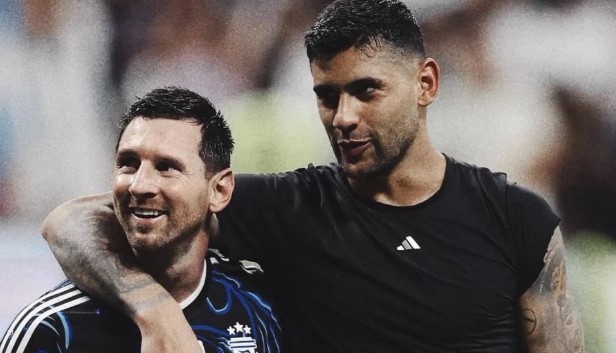

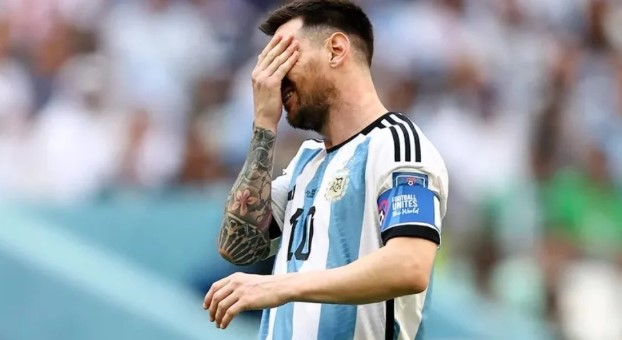
Lionel Messi is set to play what is expected to be his final match for Argentina on Tuesday, with Benin the opponents at Buenos Aires’ Monumental Stadium. The occasion will mark the end of an international career spanning more than two decades.
But ahead of Messi’s farewell, a little-known story about the beginning of his journey with Argentina has emerged: the country’s football officials initially struggled even to identify him correctly. When Argentine scouts began searching for the teenage prodigy at Barcelona, they reportedly had his name wrong.
Argentine journalist and author Sergio Levinsky, who wrote Messi and Everything Else, told Reuters that Messi’s career with the national team had gone through several distinct phases.
“Messi has gone through many stages, and each one was almost like a different era. At the beginning, he suffered tremendously with the national team. He really endured a lot,” Levinsky said.
Messi moved to Barcelona as a teenager, where Spain attempted to persuade him to represent the country. Meanwhile, Argentina knew relatively little about the youngster who had left Rosario for Spain.
At the 2003 FIFA Under-17 World Cup in Finland, Argentina lost 3-2 to Spain in the semifinals after extra time. According to Levinsky, Spanish youngster Cesc Fàbregas, who scored twice in the match, approached Argentine officials afterward.
Fàbregas was Messi’s teammate at Barcelona’s La Masia academy. He reportedly told the Argentines: “You lost to us because your best player is at Barcelona, and he is a phenomenon.”
Argentina’s youth coach Hugo Tocalli recalled a similar episode. Speaking at the Olé Summit last month, Tocalli said Spain’s head chef told him that Argentina needed “a boy who plays for Barcelona” if they wanted to win the tournament.
Finding that boy from Rosario, however, proved surprisingly difficult.
AFA employee Omar Souto reportedly searched through Rosario’s telephone directory and eventually found contact information for Messi’s family in Spain. According to the documentary Messi: The Forgotten Tape, Souto initially asked about a “Leonardo.”
He was reportedly corrected: “His name isn’t Leonardo, it’s Lionel.”
There was further confusion in the paperwork. Levinsky said the Argentine Football Association sent a fax to Barcelona asking about a player named “Mechhi.” Officials apparently thought the youngster might be Italian and added two “c”s to the name.
After all that confusion, Messi finally made his Argentina debut in 2004, playing two friendly matches for the Under-20 side. It was his first appearance in the famous blue-and-white shirt.
Yet doubts about him remained.
At the 2005 FIFA Under-20 World Cup in the Netherlands, Messi started the tournament on the bench as Argentina lost its opening match. Levinsky said there had been strong opposition to selecting a player who did not play his club football in Argentina.
“He had to fight against those initial doubts. Because he lived in Spain, he was considered a foreigner,” Levinsky said.
Messi was also criticized when he failed to immediately reproduce his Barcelona form for the national team. Some Argentine supporters even labeled him “pecho frío”—a phrase used to describe someone considered lacking in passion or emotional intensity.
The perception began to change during a 2011 World Cup qualifier against Colombia. Argentina came from behind to win a difficult match, with Messi playing a central role.
“He was exhausted, he even vomited, but he still managed to lead the team to victory,” Levinsky said. “For the first time, the supporters began to look at him differently.”
The relationship between Messi and Argentina’s supporters deepened further in 2016. After Argentina lost the Copa América final to Chile on penalties, Messi briefly announced his international retirement.
Rather than blaming him, many supporters publicly urged him to return.
“People understood that he was not responsible for the defeat. He was the one taking the team to the finals,” Levinsky said.
The transformation became even more pronounced under Lionel Scaloni.
Messi emerged as the unquestioned leader of a new generation. As captain, he became more vocal and assertive, a change particularly visible during the 2019 Copa América and in the years that followed.
His dressing-room speech before the 2021 Copa América final against Brazil has since become part of Argentina’s football folklore. Under Messi’s leadership, Argentina went on to win two Copa América titles and the 2022 World Cup.
Comparisons with Diego Maradona had followed Messi throughout much of his career. As leadership and major international success finally came together, the debate over which of the two was greater only intensified.
But Levinsky believes the comparison misses the point.
“This is the story of both Messi and Maradona. They are both extraordinary talents from different eras,” he said.
According to Levinsky, Argentina’s love for Maradona came almost immediately, while Messi’s relationship with the country developed much more gradually. Much of Messi’s upbringing and career took place abroad, and it took years for him to become emotionally close to Argentine supporters.
“Having Messi was like suddenly discovering that you have an 18-year-old son. You didn’t even know the boy existed, and now you have to love him,” Levinsky said.
“It was a love that had to develop.”