
The Middle East war has entered what may be its most dangerous chapter yet. What began as a military confrontation between Israel, the United States, and Iran has now evolved into a direct standoff over one of the world’s most critical waterways — and the consequences of miscalculation could be felt from fuel pumps in Ohio to dinner tables in West Africa.
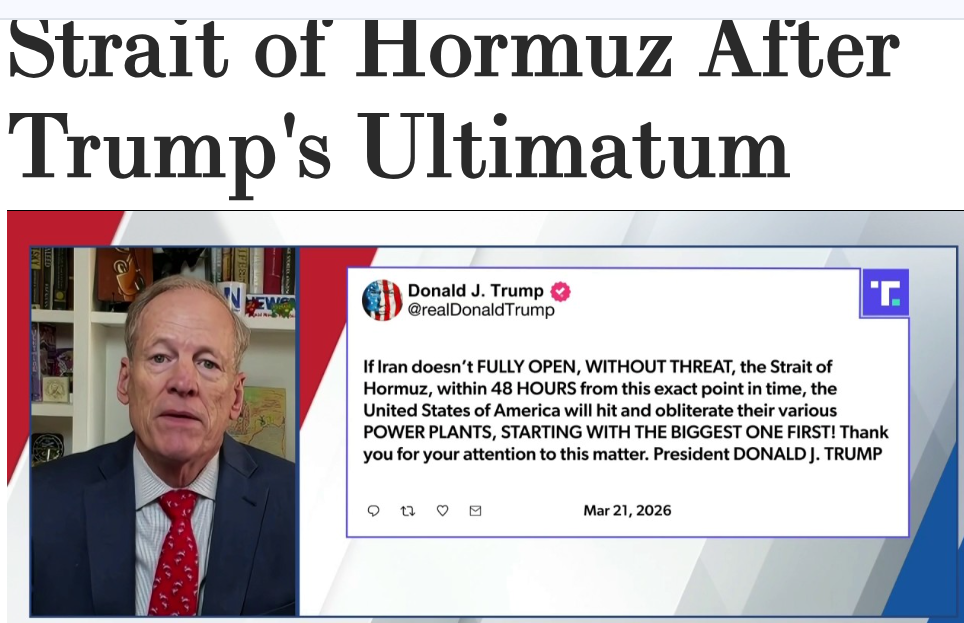
On Saturday night, President Donald Trump issued a stark 48-hour ultimatum: open the Strait of Hormuz, or watch Iran’s power plants burn — starting with the largest one first. Tehran’s response came swiftly and without hesitation. Iranian parliament speaker Mohammad Bagher Qalibaf made clear that any strike on Iranian infrastructure would
trigger a devastating response across the region. Gulf states’ energy facilities and desalination plants — the very systems that produce drinking water for millions — would become fair game. He went further, warning that those who bankroll the American military machine are also legitimate targets.
Iran’s ambassador to the United Nations put it in starker legal terms, writing to the Security Council that attacking power plants serving civilian populations would constitute a war crime, plain and simple.
The escalation didn’t come out of nowhere. On Saturday night, Iranian missiles rained down on Israel’s Negev Desert — Tehran’s retaliation for what it says was an Israeli strike on its Natanz nuclear enrichment facility. Scores of people were wounded in two southern Israeli communities located near a secretive nuclear research site. Prime Minister Benjamin Netanyahu toured the damage and, with visible relief, called it a miracle that nobody had died.
Israel’s military, for its part, insists that Iran’s missile launches have actually been declining since the war began — framing it as a sign that the campaign is working. Netanyahu echoed that confidence, saying Israel and the United States were well on track toward their war objectives: crippling Iran’s nuclear and missile programs and cutting off its network of armed proxy groups across the region.
But on the ground, there is little sign of victory — or of an end.
To the north, Lebanon is bearing the weight of a conflict it did not start. Israel’s Defence Minister, Israel Katz ordered the destruction of bridges over the Litani River, accusing Hezbollah of using them to move fighters and weapons southward. The Qasmiyeh bridge near Tyre was struck after just an hour’s warning — barely enough time for anyone nearby to flee. Lebanese President Joseph Aoun did not mince words, calling the bridge strikes “a prelude to a ground invasion.”
Hezbollah has continued firing rockets into northern Israel. One strike killed a man in the town of Misgav Am. Two days before his death, the victim — 61-year-old farmer Ofer Moskovitz — had told a radio station that living near the Lebanese border felt like playing Russian roulette.
He was not wrong.
Lebanese authorities say Israeli strikes have now killed more than a thousand people and displaced over one million. Israel has also ordered the acceleration of demolitions of Lebanese homes near the border — a move that has drawn sharp international criticism.
Since the United States and Israel launched this war on February 28, the death toll has surpassed two thousand. Iran’s health ministry says more than fifteen hundred of its citizens have been killed. In Israel, fifteen people have died from Iranian strikes. Across Lebanon, the toll climbs daily. Civilians in the occupied West Bank and several Gulf Arab
states have also been caught in the crossfire.
On Saturday, a Qatari military helicopter crashed due to a technical malfunction, killing all seven people on board.
Meanwhile, the International Atomic Energy Agency has confirmed that the bulk of Iran’s enriched uranium stockpile now lies buried under the rubble of its Isfahan facility — raising urgent questions about nuclear containment that no one yet has answers to.
Israeli military spokesman Brigadier General Effie Defrin was blunt about what comes next: more weeks of fighting, he said, are expected.
The Strait of Hormuz remains effectively closed. Oil prices remain elevated. Supply chains are groaning. And with Trump’s deadline now ticking, the world is watching a narrow strip of water — and wondering whether the next 48 hours will change everything.