

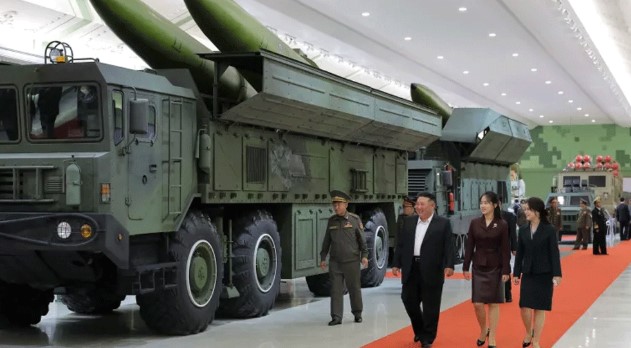
North Korea has test-fired two types of strategic cruise missiles designed for submarine launch, according to the country’s state-run Korean Central News Agency (KCNA). The tests, conducted in waters off the country’s eastern coast on Wednesday, October 14, were aimed at assessing naval combat readiness and strengthening the reliability of Pyongyang’s deterrence capabilities.
KCNA reported on Thursday that the exercise was intended to improve the navy’s ability to carry out strategic missions. Senior military officials observed the launches, and the agency claimed the tests had no adverse impact on the security of neighbouring countries.
One of the missiles was identified as the Pulhwasal-3-31, the same type of strategic cruise missile that North Korea said it had tested from land the previous week. The latest launches form part of a broader push by leader Kim Jong Un to expand the country’s missile arsenal and develop a stronger naval deterrent.
Submarine capabilities remain a strategic priority
Developing a capable missile submarine fleet has become a major military priority for Kim. Although North Korea has demonstrated submarine-launched missile technology, questions remain about the operational readiness and effectiveness of its underwater weapons systems.
The latest test may indicate progress in the country’s submarine programme. South Korean news agency Yonhap reported that the missiles may have been launched from the Hero Kim Kun Ok, a submarine North Korea unveiled in 2023 and described as a tactical nuclear-attack vessel. South Korean military officials said the two missile types appeared to have been fired using different launch systems.
During a visit to a submarine production facility last year, Kim criticised a nuclear-powered submarine agreement between the United States and South Korea. North Korean state media described the agreement as a threat to stability on the Korean Peninsula.
Images released at the time showed an 8,700-tonne nuclear-powered missile submarine under construction. Pyongyang has repeatedly argued that expanding its naval and missile capabilities is necessary to counter what it considers military threats from Washington and Seoul.
A series of missile tests raises tensions
The submarine-launched cruise missile tests follow several other weapons demonstrations by North Korea in recent weeks.
On October 12, Pyongyang launched multiple ballistic missiles towards waters off its eastern coast. South Korea’s military detected the launches, while Seoul criticised the tests amid worsening relations between the two Koreas.
North Korea also tested a hypersonic intermediate-range missile on October 3. The weapon was reportedly designed to complicate missile-defence efforts by South Korea and Japan.
Following the earlier ballistic missile launches, South Korean Joint Chiefs of Staff spokesperson Jang Do-young described North Korea’s actions as an apparent show of force, noting that they came shortly after South Korea conducted a test of its own hypersonic weapon.
Regional security concerns persist
The latest developments highlight the continuing competition between North and South Korea to strengthen their respective military capabilities. Seoul has been expanding its deterrence options alongside its security partnership with the United States, while Pyongyang continues to pursue ballistic missiles, cruise missiles and submarine-based weapons.
A reliable submarine-launched weapons capability could make North Korea’s arsenal more difficult to track and potentially strengthen its ability to respond to an attack. However, the extent to which its submarine fleet can conduct sustained operational missions remains uncertain.
With diplomatic efforts between Washington and Pyongyang stalled, the latest tests add to regional security concerns and underscore the continuing challenge of reducing military tensions on the Korean Peninsula.