

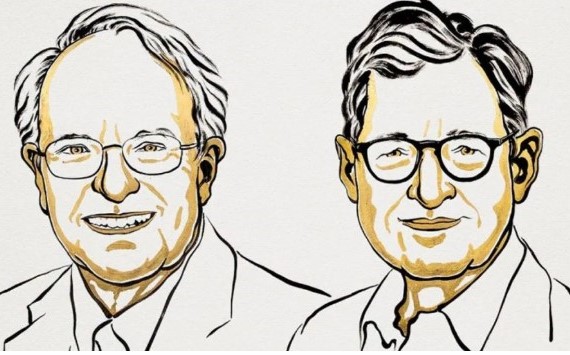
American economists Robert E. Hall and Michael Woodford have jointly won the 2026 Nobel Prize in Economic Sciences for research that has strengthened the theoretical basis of economic stabilisation policies used by governments and central banks around the world.
The Royal Swedish Academy of Sciences announced the award on Monday, October 12, recognising their work on the microeconomic foundations of macroeconomic stabilisation. The prize carries an award of 12 million Swedish kronor, equivalent to approximately $1.2 million.
Research That Helps Policymakers Manage Economic Shocks
Governments and central banks regularly face the challenge of responding to recessions, rising inflation and periods of rapid economic growth. Their decisions on interest rates, public spending and other policy measures can influence employment, consumption, investment and prices.
Hall and Woodford helped develop economic models that explain how these policy choices affect the broader economy. Their work connects large-scale indicators—such as inflation and output—with the decisions made by individual consumers, households and businesses.
The need for improved models became particularly apparent during the economic disruptions of the 1970s, when oil shocks coincided with sluggish growth, high unemployment and persistent inflation in many Western economies. Those developments exposed weaknesses in existing approaches to managing economic fluctuations and prompted economists to reconsider how policy decisions should be assessed.
Linking Individual Decisions to the Wider Economy
A central contribution of the two economists’ research is its emphasis on the choices people and businesses make in response to economic conditions.
Households decide how much to spend or save partly on the basis of their expectations about future income. Businesses consider anticipated demand, costs and monetary policy when setting prices and planning investment. Bringing these decisions into macroeconomic models helps policymakers better understand how changes in interest rates, government spending or market conditions can spread throughout the economy.
The approach has helped provide a stronger theoretical framework for analysing the effects of fiscal and monetary policy, particularly during periods of uncertainty.
Why Expectations Matter
Expectations about the future are another important element of their work. Consumers and businesses do not respond only to present economic conditions; they also consider what they believe will happen next.
When a central bank signals its likely approach to interest rates, for example, that announcement can influence borrowing, spending, investment and companies’ pricing decisions before any policy change takes effect. Clear communication from policymakers can therefore become an important part of economic management.
According to the prize committee, the laureates’ research has established a robust theoretical foundation for models used by central banks and governments internationally. These tools can help officials assess how to respond to economic shocks, including sudden increases in energy prices or major changes in household spending.
Hall is affiliated with Stanford University in California, while Woodford is associated with Columbia University in New York. Their work has influenced modern thinking on macroeconomic fluctuations and the role of monetary policy.
Last Year’s Laureates
The 2025 economics prize went to Joel Mokyr, Philippe Aghion and Peter Howitt for research explaining how innovation and technological change drive long-term economic growth. Their work examined how new ideas and production methods can transform economies and improve living standards.
The History of the Economics Prize
The economics award is formally known as the Sveriges Riksbank Prize in Economic Sciences in Memory of Alfred Nobel. Unlike the original Nobel prizes established under Alfred Nobel’s will, it was created in 1968 by Sweden’s central bank and first awarded in 1969.
The economics prize is announced by the Royal Swedish Academy of Sciences in Stockholm. Awards in medicine, physics, chemistry, literature and economic sciences are presented in Stockholm, while the Nobel Peace Prize ceremony takes place in Oslo, Norway.