

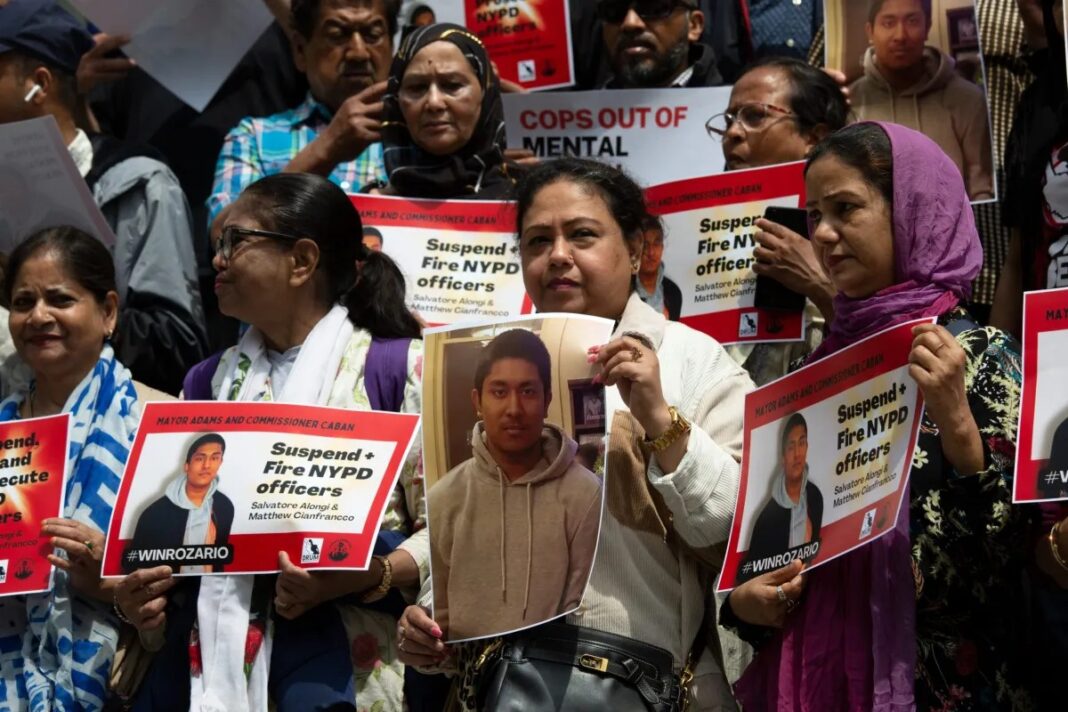
The police officer who was supposed to face a disciplinary trial will ultimately escape that process—not because of a legal manoeuvre or political intervention, but because of a seemingly minor administrative failure. According to the New York Police Department’s own admission, officials failed to send a required statutory notification.
Salvatore Alongi, the officer accused in the March 2024 fatal shooting of 19-year-old Bangladeshi American Win Rozario in Ozone Park, Queens, has retired. The Civilian Complaint Review Board (CCRB) had found substantiated allegations of excessive force and abuse of authority against him.
Under department rules, when an officer facing disciplinary charges applies for retirement, the CCRB must be notified so that it can expedite the disciplinary process. In Alongi’s case, that notification was never sent.
Police Commissioner Jessica Tisch publicly acknowledged the error and apologised on Thursday. She said a “human error” had prevented the board from being notified before the pension board considered Alongi’s application for a disability pension. The department placed responsibility on a civilian employee, who was reportedly demoted and removed from disciplinary-related duties.
The commissioner’s statement came about an hour after the Rozario family held a press conference outside City Hall. Their anger was directed not only at the police department but also, perhaps even more intensely, at Mayor Zohran Mamdani, whom they had once regarded as an ally.
Win’s mother, Noton Eva Costa, directly addressed the mayor, saying he had visited her home and promised to be a different kind of mayor. Today, she said, the family feels betrayed. In her words, this was “a betrayal,” not justice.
Win’s father, Francis Rozario, went further, describing the failure not as negligence but as a deliberate cover-up and corruption at the highest levels of the police department.
Alongi applied for a disability pension in August 2025, approximately 17 months after the shooting and about three weeks before the CCRB issued its findings. In September, Tisch notified two officers that they faced disciplinary charges. At that point, the department should have informed the CCRB so the pension fund could temporarily suspend consideration of the application.
Because that notification never came, the CCRB did not learn of Alongi’s retirement until August, nine weeks after his final day on the job.
CCRB spokesperson Dakota Gardner declined to comment on the failure. The spokesperson said only that disciplinary proceedings against the other officer accused in the shooting, Matthew Cianfrocco, would continue “as planned,” although no date has been set.
The events of March 27, 2024, were captured on body-camera footage. After responding to a call from Win’s mother, the two officers arrived at the kitchen doorway, where Win picked up a pair of scissors. Alongi immediately deployed a Taser.
Win’s mother took the scissors away and placed them on a chair, pleading with the officers not to shoot her son. Nevertheless, a second Taser shot followed. Win picked up the scissors again and moved forward. Cianfrocco fired once and then fired four more shots.
The entire incident lasted approximately two minutes. According to reports, Win died at the scene.
The New York State Attorney General’s Office subsequently decided not to bring criminal charges against either officer. The case has drawn support for the family from members of Queens’ Bangladeshi Christian community, Drum and other civic organisations, as well as public advocate Jumaane Williams.
The central question, therefore, is not simply whether an employee made a mistake. The NYPD has not explained its role in the consideration of Alongi’s pension. A disability pension can provide three-quarters of an officer’s final-year salary, compared with 50 per cent under a standard pension arrangement. The pension board approved Alongi’s application on May 18. The department has not answered questions about the circumstances that qualified him for this benefit.
A new two-tier oversight system is now being introduced. It will include a supervisor responsible for direct communication with the CCRB and a departmental advocate who will personally notify the board and seek to have pension applications suspended when necessary.
A system that had not existed before is being established only after a single administrative failure helped derail a disciplinary case.
One of Mamdani’s campaign promises was to send mental health professionals, rather than police officers, to respond to people experiencing crises. Win Rozario was in precisely the kind of crisis that raised questions about how such responses should be handled.
A city that promised to respond differently when a mother called for help must now confront a difficult question: Is its system so deeply flawed that when a file fails to reach the right desk, accountability for a human life can also fail to arrive?