

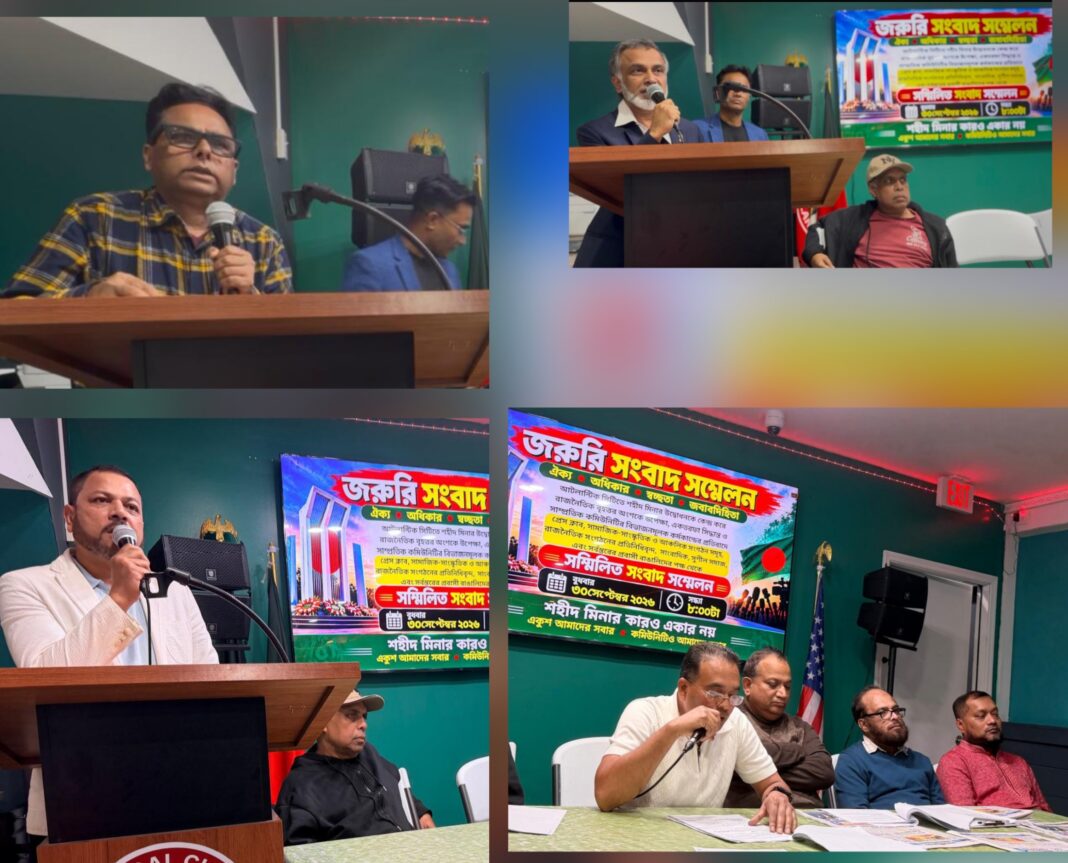
ATLANTIC CITY, New Jersey — The newly inaugurated permanent Shaheed Minar in Atlantic City has become the focus of division, disappointment and anger within the Bangladeshi American community. Against this backdrop, political, social, cultural and regional organizations, along with members of civil society from Atlantic City and South Jersey, held a press conference calling for recognition of the monument’s history, protection of its dignity and greater community unity.
The press conference was held Wednesday evening, September 30, at the Bengal Club. Organizers emphasized at the outset that they were not there to personally attack any individual or organization. Rather, they said their objective was to present what they described as the historical truth, uphold the dignity of the Shaheed Minar, and speak for community unity and collective ownership of the monument.
The event was moderated by Kajal Sarkar.
Speakers said the history of observing International Mother Language Day, or Ekushey February, in Atlantic City goes back many years. According to them, the Bengal Club of Atlantic City has organized the observance since 2000. They said the organization never considered February 21 to be its exclusive event or property. Instead, it played a leading role in bringing together people representing different political views, including supporters of the Awami League and BNP, as well as social, cultural and regional organizations, to observe Ekushey collectively.
Speakers said that when the idea of establishing a permanent Shaheed Minar in Atlantic City emerged in 2023, representatives of the Bengal Club, along with leaders of the Awami League, BNP and various social and regional organizations, came together under the leadership of Mohammad Akbar Hossain, president of the Atlantic City Bangladesh Press Club.
They said this collaborative effort continued in 2024. With financial contributions from members of the broader community and the labor and dedication of Bengal Club members, a temporary wooden structure modeled on a permanent Shaheed Minar was subsequently built at the site. According to the speakers, the temporary monument remained there through 2025 and into 2026, at the same location where the current permanent Shaheed Minar was eventually constructed.
The press conference effectively turned into a community protest meeting.
Among those who spoke were writer and journalist Ibrahim Chowdhury, Helal Hasan, Ali Chowdhury, Mohammad Didar, Sheikh Amin, Saeed Doha, Paplu Chowdhury, Faruk Hossain, Enamul Haque, Sabur Mia, Akbar Hossain, Mohammad Shahin, Zakir Hossain, Monirul Alam Babu, Aulad Hossain and others.
A major point of contention raised at the press conference concerned the role of the Bengal Club in the permanent Shaheed Minar project.
Organizers alleged that the official ribbon-cutting flyer and press materials issued by Downtown CDC, described as the principal organization behind the project, explicitly identified the Bengal Club of Atlantic City as a community partner. They argued that the Bengal Club therefore was not an outside or uninvited organization, but one whose involvement had been publicly acknowledged in the project’s own promotional materials.
Despite that, organizers alleged that a representative of the Bengal Club was not given an opportunity to speak at the inauguration ceremony.
Speakers stressed, however, that their objection was not simply about being denied an opportunity to speak. They said the larger question was why the broader community—including political, social, cultural and regional organizations, the press club, Lions Club, business associations and other civic representatives—was not adequately involved in the historic inauguration process.
Another incident at the event drew strong concern from the speakers. Citing journalist Shubrat Chowdhury, they said Atlantic County Bangladesh Association representative Shahid Khan publicly told him, “You are a false journalist. You write false stories.”
Chowdhury reportedly responded that the writing in question was not a news report published by any newspaper, but rather his own personal writing posted on Facebook.
According to organizers, the incident occurred in front of a large gathering and left the journalist embarrassed and humiliated. They said he became emotional following the exchange.
Speakers argued that disagreement with a journalist’s writing is legitimate, and that criticism can be addressed through facts, clarification or a public request for correction. But, they said, disagreements should not turn into personal insults. They described the incident as particularly painful because it allegedly took place in front of the Shaheed Minar—a monument associated with the struggle for language rights and freedom of expression.
The speakers also raised questions about what took place during the inauguration ceremony itself.
According to representatives who said they were present at the event, the national anthem of Bangladesh was not performed and no one-minute silence was observed in memory of the language martyrs. The speakers said that different claims were subsequently circulated regarding whether those observances had taken place, and they disputed those accounts.
They called for the release of the full video of the inauguration, or other credible evidence, if the national anthem was in fact performed and a moment of silence was observed.
At the press conference, organizers presented four specific demands.
First, they called for the complete history of the Shaheed Minar project to be documented and presented, with appropriate recognition given to the individuals and organizations involved from 2023 to the present.
Second, they called for open consultation and coordination with political, social, cultural and regional organizations, the press club, Lions Club, business associations and other active community representatives in future programs related to the Shaheed Minar and Ekushey February.
Third, they called for the Shaheed Minar to remain a universal memorial belonging to the entire community, rather than becoming a symbol of exclusive credit or control by any individual, organization or limited group.
Fourth, they called for personal and organizational disagreements to be kept separate from the Shaheed Minar and resolved through dialogue whenever necessary.
The speakers repeatedly emphasized that they did not want to declare anyone an enemy, diminish the contributions of any organization or create another form of division.
As they put it:
“We do not want conflict—we want respect.
We do not want domination—we want participation.
We do not want exclusive credit—we want rightful recognition of history.
We do not want division—we want unity.”
At the conclusion of the press conference, speakers warned that if a monument intended to symbolize community unity becomes a source of further division, the physical structure may stand, but the spirit of Ekushey February will not be fully realized.
They called on members of the community to stand together before the same Shaheed Minar next February 21 and urged everyone to look beyond current disagreements.
For future generations, they said, the community should leave behind not only a permanent Shaheed Minar, but also an honest history and a united comHistory