
A major diplomatic contest is underway for the United Nations’ top leadership position, with the Security Council and General Assembly formally beginning the process of selecting the organization’s next secretary-general.
UN Secretary-General António Guterres is due to complete his term at the end of 2026, with his successor set to take office on January 1, 2027. The selection process will involve nominations and preliminary screening of candidates from different regions before a final decision is reached.
Latin America and Female Leadership in Focus
Analysts believe the next secretary-general could come from Latin America, as the position has traditionally rotated among the world’s regions. The last Latin American to serve as UN secretary-general was Peru’s Javier Pérez de Cuéllar, who left office in 1992.
Another major issue in this year’s race is gender. Eighty years after the UN was founded, no woman has ever served as secretary-general. There have therefore been longstanding informal calls for the organization to appoint its first female leader.
The next secretary-general, however, will inherit a UN facing significant challenges. The United States, the organization’s largest financial contributor, has reduced its voluntary funding and withdrawn from the World Health Organization. At the same time, unpaid contributions from member states have contributed to a difficult liquidity situation at the UN.
During Guterres’ tenure, the UN has struggled to end conflicts in Gaza and Sudan and has been unable to stop Russia’s war in Ukraine. Making the organization more effective will therefore be one of the biggest challenges facing the next secretary-general.
How Is the UN Secretary-General Chosen?
The selection process began in late November 2025, when the presidents of the UN General Assembly and Security Council formally invited member states to nominate candidates.
Under the UN Charter, the 15-member Security Council recommends a candidate, whose appointment must then be approved by the 193-member General Assembly.
The decisive battle, however, takes place in the Security Council. A candidate needs the support of at least nine council members and must avoid a veto from any of the five permanent members—the United States, the United Kingdom, France, Russia and China.
The council initially assesses candidates through confidential, informal straw polls. Members indicate whether they are “encouraging,” have “no opinion” or are “discouraging” toward each candidate.
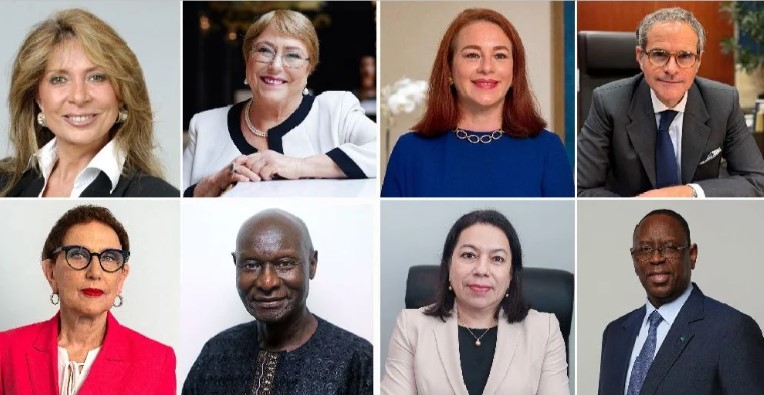
Two rounds of such voting have been held so far. After the second round, Guyana’s candidate, Caroline Rodrigues-Birkett, emerged as the frontrunner, followed by Costa Rica’s Rebeca Grynspan and Argentina’s Rafael Mariano Grossi.
Caroline Rodrigues-Birkett — Guyana
Caroline Rodrigues-Birkett, Guyana’s ambassador to the UN, previously served as the country’s foreign affairs minister and minister for indigenous affairs. She represented Guyana on the Security Council in 2024–25.
Her campaign emphasizes protecting the interests of smaller states while giving equal importance to peace and security, development and human rights.
In the second straw poll, she received eight “encouraging,” three “discouraging” and four “no opinion” votes, putting her at the top of the race.
Rebeca Grynspan — Costa Rica
Rebeca Grynspan is secretary-general of the UN Conference on Trade and Development (UNCTAD). She previously served as Costa Rica’s vice president and deputy finance minister.
She played an important role in UN-led negotiations surrounding the Black Sea Grain Initiative in 2022.
Grynspan has proposed restructuring the secretary-general’s office, strengthening mediation capabilities, reducing overlapping responsibilities among UN agencies and expanding the use of technology and artificial intelligence.
She received 10 “encouraging” votes in the first poll in July, but that number fell to seven in the second round in August.
Rafael Mariano Grossi — Argentina
Rafael Mariano Grossi is director-general of the International Atomic Energy Agency and has nearly four decades of diplomatic experience.
His vision for the UN focuses on peace and security, development, human rights, administrative reform and pragmatic multilateralism.
Grossi received seven “encouraging” votes in the August poll, placing him second. However, he also received six “discouraging” votes.
His candidacy faces another potential obstacle: the long-running dispute between Argentina and the United Kingdom over the Falkland Islands. As a permanent member of the Security Council, the UK could veto his candidacy.
María Fernanda Espinosa — Ecuador
Former Ecuadorian Foreign Minister María Fernanda Espinosa served as president of the UN General Assembly in 2018–19. She was the fourth woman to hold the position and the first woman from Latin America and the Caribbean to do so.
One of her key proposals is the creation of a “Prevention and Early Action Hub” to identify risks and respond to emerging crises before they escalate.
However, she received only four “encouraging” votes in the August poll, leaving her well behind the leading candidates.
Michelle Bachelet — Chile
Former Chilean President Michelle Bachelet has also served as the UN High Commissioner for Human Rights.
She has called for reforms to the UN’s internal bureaucracy, stronger engagement with ordinary people and more effective mechanisms for dealing with future crises.
Her support, however, fell significantly in the August poll. She received just two “encouraging” votes and six “discouraging” votes.
Macky Sall — Senegal
Macky Sall served as president of Senegal from 2012 to 2024. His campaign centers on the idea of “new and inclusive multilateralism.”
He has pledged to strengthen the UN’s conflict-prevention mechanisms, review its administrative structure and prioritize human rights and development.
However, his candidacy faces two major political hurdles: expectations that the next secretary-general should come from Latin America and growing calls for the UN’s first female secretary-general.
Olara Otunnu — Uganda
Olara Otunnu, an experienced Ugandan diplomat, has spent more than four decades working in international diplomacy. He has served as Uganda’s ambassador to the UN and as the country’s foreign minister.
He has said that conflicts in Ukraine, Gaza, Congo, Sudan and Iran would be among his priorities from his first day in office.
His support increased the most among the candidates between the July and August Security Council polls. However, as a male candidate from outside Latin America, he could face political disadvantages in the current race.
Ivonne A-Baki — Ecuador
Ecuadorian diplomat and former trade minister Ivonne A-Baki entered the race after being nominated by Tonga.
Her campaign focuses on conflict prevention and reform of the UN Security Council. She supports permanent representation on the council for historically underrepresented regions, including Africa, Latin America and the Caribbean.
However, her candidacy currently appears to be the weakest. She received no “encouraging” votes in the August poll, while eight members voted “discouraging” and seven expressed “no opinion.”
What Comes Next?
Discussions and lobbying around the candidates are expected to intensify during the UN General Assembly session.
Ultimately, securing the support—or at least avoiding the veto—of the five permanent Security Council members will be crucial.
For now, Guyana’s Caroline Rodrigues-Birkett has emerged as the frontrunner, but the race remains far from decided. The balance of support could shift significantly over the coming weeks as diplomatic negotiations and lobbying intensify.