
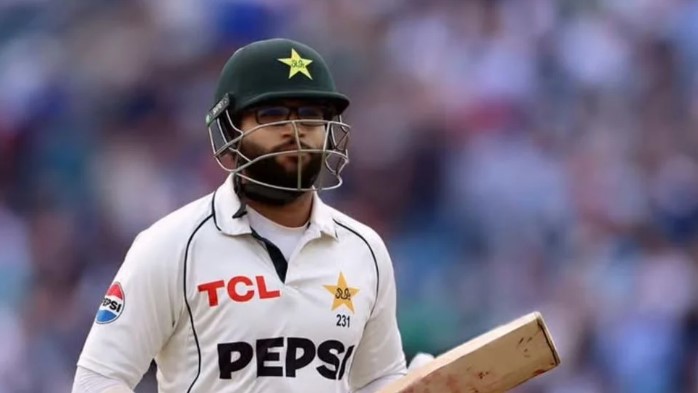
Pakistan Cricket Board (PCB) officials are set to investigate the nature of Imam-ul-Haq’s injury after the left-handed opener missed both innings of the Lord’s Test against England.
Imam was included in Pakistan’s playing XI but did not bat because of a muscle injury in his left leg. His decision to stay out of both innings quickly became a subject of debate, with some questioning whether the injury was as serious as reported.
Aqib Javed Questions Imam’s Absence
Pakistan’s High Performance Department director Aqib Javed has now openly raised concerns about the incident. Speaking to Pakistani media outlet Geo, the former fast bowler said he was “deeply disappointed” and indicated that Imam would have to answer questions as part of an investigation.
“There are major questions surrounding Imam’s injury, and I am deeply disappointed,” Aqib said. “In the past, players have tried to take the field even after suffering injuries. We will take action in this case. How can a muscle strain completely prevent someone from batting in both innings? He should have tried and fought.”
Aqib, however, stopped short of accusing Imam of deliberately faking the injury.
“I cannot say for certain whether he was pretending to be injured,” he said. “But this kind of muscle strain should not completely prevent you from batting.”
Imam’s Training Session Adds to the Debate
The PCB announced Imam’s injury only minutes before play began on the second morning at Lord’s. The board said he had suffered a muscle problem in his left leg and that his availability for the remainder of the match would depend on medical advice.
Ultimately, Imam did not bat during the Test. However, he was seen training with his teammates on the morning of the fourth day, prompting further criticism.
Former England fast bowler Stuart Broad questioned Imam’s training session while on commentary, describing it as an apparent attempt to “put on a show.” Former Australia opener David Warner also criticized the Pakistan batter on social media.
Following Pakistan’s heavy defeat, Imam was among seven players sent back home.
Major Changes in Pakistan’s Setup
Pakistan have made several significant changes following their poor performances against England. Along with sending seven players home, the PCB has also removed head coach Sarfaraz Ahmed and bowling coach Umar Gul from their positions.
Aqib defended the decisions by pointing to Pakistan’s inability to seriously challenge England across the first two Tests.
“Two Tests have been played, but the team has not been competitive at all,” he said. “There is still one Test remaining. We had a pace-bowling all-rounder, a second wicketkeeper and a fast bowler like Ubaid Shah, but none of them were used.”
Aqib said he had discussed the possibility of selecting Ubaid Shah with captain Babar Azam and the coaching staff. He believes the young pacer could have added greater pace and variety to Pakistan’s attack.
Concerns Over Team Selection
Aqib also criticized the balance of the playing XI, arguing that Pakistan lacked bowling options among their top-order batters.
“None of our first seven batters bowls. We should have had an all-rounder,” he said. “Most importantly, Ubaid Shah should have played. He bowls at around 140 kilometers per hour, and a genuinely quick bowler can change the entire structure of a bowling attack.”
He also addressed Salman Agha’s recent form, saying he understood the decision to leave him out because of his struggles. However, Aqib suggested that Ghazi Ghori should have been selected behind the stumps instead of Mohammad Rizwan.
Aqib Defends His Own Role
Pakistan’s continued instability has also raised questions about Aqib’s role. He has overseen the High Performance Department for nearly two years, during which the national team has gone through several coaching changes, including Jason Gillespie and Gary Kirsten.
Aqib has also served in selection and coaching roles and was reportedly influential in appointing Sarfaraz Ahmed as head coach only three months ago. Sarfaraz was removed after just six Tests, while former captain Misbah-ul-Haq recently resigned from the selection panel following changes to the team structure.
Aqib, however, said he has no plans to follow Misbah out of the setup.
He argued that coaches and captains are responsible for selecting the squad, while match-day decisions during an overseas tour are largely beyond the direct control of the selection and high-performance departments.
“When we select a squad and build a team as coaches or administrators, that team is our responsibility,” Aqib said. “But once the team goes on tour, we cannot control the match-by-match selections. Nobody questioned these players’ performances when the squad was selected. But when players completely lose form and the team cannot compete, we have to make decisions.”
He added that responsibility also lies with the captain, head coach and team management when the right combination is not used despite clear instructions.
Backing for Mike Hesson
Aqib also expressed confidence in Pakistan’s new Test coach Mike Hesson, who has been handed responsibility for both red-ball and white-ball cricket.
“A team is not run by one person. The coach and captain manage it together,” Aqib said. “Mike Hesson has taken charge, and we will try to support him in every possible way. Let’s see how Babar and Mike work together.”
He acknowledged that immediate results should not be expected, but stressed that Pakistan still possess considerable cricketing talent.
Pakistan will face England in the third and final Test of the series from September 9 at Edgbaston in Birmingham.