

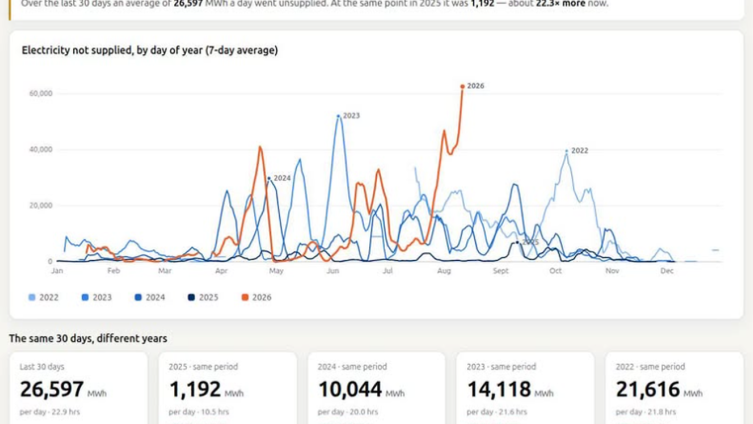
Bangladesh is experiencing its most severe electricity shortage in recent years, with Dhaka and several other parts of the country facing prolonged power cuts. A five-year comparison based on publicly available data from the Power Grid Company of Bangladesh (PGCB) and Bangladesh Power Development Board (BPDB) shows that the current crisis has reached its highest level since 2022.
According to the analysis, an average of 26,597 megawatt-hours (MWh) of electricity went unserved each day over the past 30 days. During the same period in 2025, the average was just 1,192 MWh per day—meaning the electricity supply shortfall has increased by approximately 22.3 times in one year.
The comparison with previous years also highlights the severity of the current situation. During the corresponding period, the average daily supply shortfall was:
2026: 26,597 MWh
2025: 1,192 MWh
2024: 10,044 MWh
2023: 14,118 MWh
2022: 21,616 MWh
The analysis compares electricity supply data for the same dates each year and uses a seven-day moving average to reduce the impact of daily fluctuations. The data show that the 2026 trend rose sharply during August, at one point approaching 55,000–60,000 MWh.
The figures suggest that the current electricity crisis is not simply the result of isolated spikes in demand or individual days of heavy load shedding. Instead, the country has been experiencing a sustained and worsening gap between electricity demand and available supply.
The impact is being felt from the capital to various parts of the country, where frequent and extended power outages are disrupting daily life and economic activity.
The five-year comparison therefore paints a stark picture: Bangladesh’s ongoing power shortage has become a large-scale supply crisis rather than merely a series of isolated load-shedding incidents.