

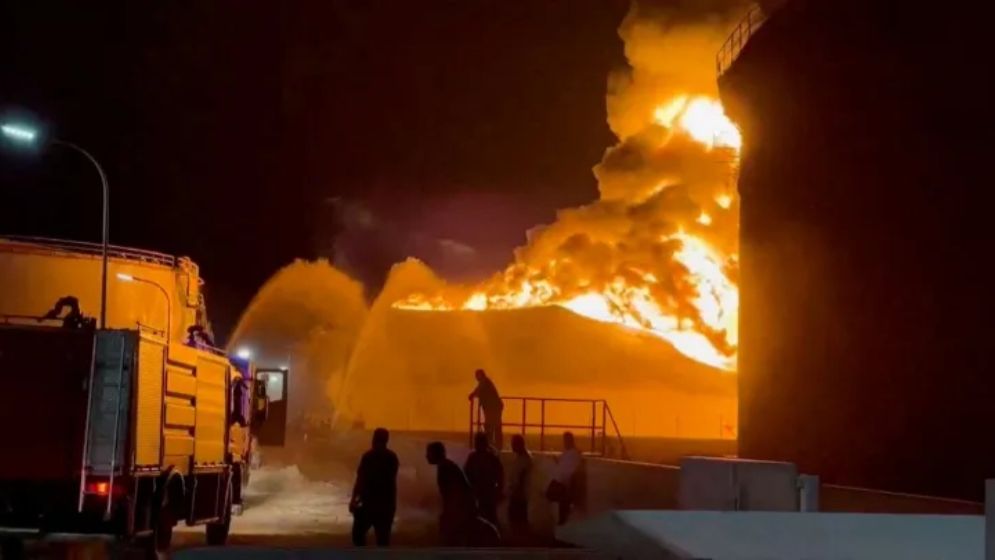
A major fire broke out at the Zawiya oil refinery west of Libya’s capital, Tripoli, after a drone attack targeted the facility on Monday evening. Emergency teams were deployed to contain the blaze.
The incident marks the third reported attack in the Zawiya area within just two days, highlighting the continuing security problems facing the country’s vital energy infrastructure.
Libya’s National Oil Corporation (NOC) said a drone struck a fuel storage tank with a capacity of around 4.5 million litres. The impact triggered a fire that eventually caused the tank to collapse.
The NOC warned that continued attacks could force authorities to temporarily suspend operations at the refinery.
Libya’s Ambulance and Emergency Service said on Tuesday that there were no reports of serious injuries. Most of those treated were suffering from breathing difficulties caused by heavy smoke.
Libya’s largest operating refinery
Zawiya is the largest currently operating oil refinery in Libya, with the capacity to process roughly 120,000 barrels of crude oil per day.
The latest attack follows two other drone strikes in the same area in recent days. According to the NOC, one attack targeted a naphtha storage facility, while another hit a water-treatment plant.
The oil corporation has called for an investigation to identify those responsible for the attacks.
The repeated strikes have raised fresh concerns over the security of Libya’s oil infrastructure, which remains crucial to the country’s economy.
Another sign of Libya’s instability
The attacks also underline the political and military instability that has persisted in Libya since the fall of longtime leader Muammar Gaddafi.
Gaddafi seized power in 1969 and ruled Libya for more than four decades. He was overthrown and later killed in 2011 during an uprising backed by Western military intervention.
Since his fall, Libya has struggled with competing political and military factions. The country has effectively been divided between rival power centres.
In the west, the internationally recognised administration based in Tripoli is led by Prime Minister Abdul Hamid Dbeibah. In the east, forces aligned with military commander Khalifa Haftar maintain significant influence.
The latest attacks on Zawiya’s energy facilities demonstrate how Libya’s prolonged political divisions continue to pose risks to critical infrastructure and the country’s oil industry.