
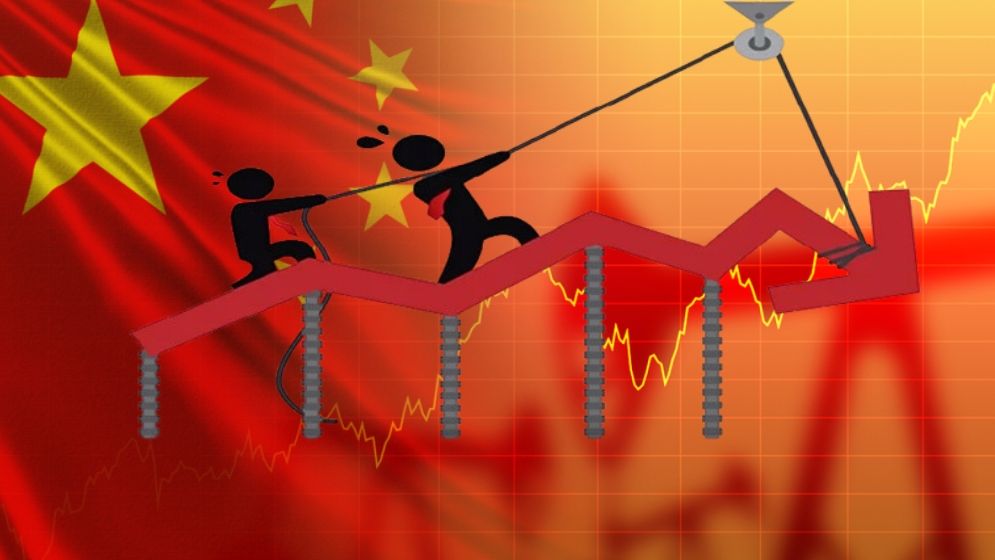
China’s economy may appear resilient from the outside, but growing structural weaknesses are becoming increasingly difficult to ignore. With domestic demand remaining weak, Beijing is relying heavily on subsidised manufacturing and exports to keep economic growth going—putting increasing pressure on trading partners around the world.
China appears on course to record another year with a trade surplus exceeding $1 trillion. Data released last Friday showed that the country’s exports jumped 24 percent in July compared with the same month a year earlier.
Behind those impressive export figures, however, the domestic economy is showing signs of prolonged weakness. Official figures indicate that China’s economic growth slowed to 4.3 percent in the second quarter of 2026, its weakest pace in roughly three years. Property prices continue to fall, while developers and local governments are struggling under heavy debt burdens. Youth unemployment has also remained elevated, approaching 15 percent.
Domestic demand remains weak
One of Beijing’s biggest challenges is a lack of consumer spending. With households reluctant to increase expenditure, the government has increasingly turned to overseas markets to support industrial activity.
Manufacturers of electric vehicles, steel producers and other industrial companies have benefited from a range of government measures. These include low-cost financing, tax incentives, inexpensive access to land in government-backed industrial zones and, in some cases, direct financial support.
This approach has been developing for years. According to OECD data, companies in 15 major Chinese industries received government support between 2005 and 2024 at levels estimated to be three to eight times higher than those received by companies in other major economies.
China’s export strength therefore does not simply reflect market demand. Government support has played an important role in allowing manufacturers to maintain production and compete aggressively overseas.
At the same time, Chinese consumers have become increasingly cautious. Household savings have traditionally been high, but economic uncertainty appears to be making people even less willing to spend.
Retail sales fell in May for the first time since the pandemic lockdown period. Investment in fixed assets—including factories, buildings and machinery—also declined by 4.1 percent during the first five months of the year.
A reform debate that has lasted decades
Chinese leaders have long acknowledged the need to reduce the economy’s dependence on exports and investment while encouraging household consumption.
In 2007, then-Premier Wen Jiabao famously described China’s economic model as unstable, unbalanced, poorly coordinated and ultimately unsustainable. Yet many of the underlying problems identified at the time remain unresolved nearly two decades later.
During Donald Trump’s first presidency, Washington also attempted to push Beijing toward structural economic changes as part of the initial phase of a trade agreement. One of the key demands was that China reduce the role of state subsidies. That issue was ultimately left for a later stage, which never materialised.
Beijing has shown little willingness to abandon the system of state support that has helped build its manufacturing base.
Why Chinese households save so much
Economists argue that China’s weak consumer spending is closely linked to the country’s limited social safety net.
Chinese households tend to save heavily because pensions, healthcare coverage, education support and other forms of social protection remain insufficient for many people. Savings therefore provide families with protection against unemployment, illness, retirement and other financial risks.
A shift toward a consumption-driven economy would require more resources to move from state-controlled sectors and government-supported industries toward ordinary households.
That would represent a significant political as well as economic change. President Xi Jinping has resisted several reforms that economists believe could encourage households to save less and spend more. He has also criticised what he describes as excessive “welfarism,” signalling caution toward expanding state-funded social protection on a large scale.
Exports give Beijing leverage—but create tensions abroad
As domestic consumption remains weak, China’s dependence on exports is increasingly becoming an international issue.
A huge volume of subsidised Chinese products entering global markets can put pressure on manufacturers in other countries, particularly in industries such as electric vehicles, steel and clean-energy technology. Governments facing competition from Chinese producers may respond with tariffs, trade restrictions or other protective measures.
The issue could become particularly important in China-US trade relations. Xi Jinping is expected to visit Washington on September 24, and Beijing’s continued dependence on exports could give the United States additional leverage in negotiations.
The relationship is not entirely one-sided, however. The United States also depends on China for rare-earth elements and other strategically important minerals that are crucial to several advanced industries.
That means the economic relationship between the two countries remains highly interdependent. China’s export dependence gives Washington one source of leverage, while Beijing’s control over critical minerals gives it another.
The larger question is whether China can eventually shift from an economy driven by state-backed production and exports toward one powered more by household consumption. Until that transition takes place, the cost of China’s domestic economic imbalance is likely to continue spreading into global trade.