
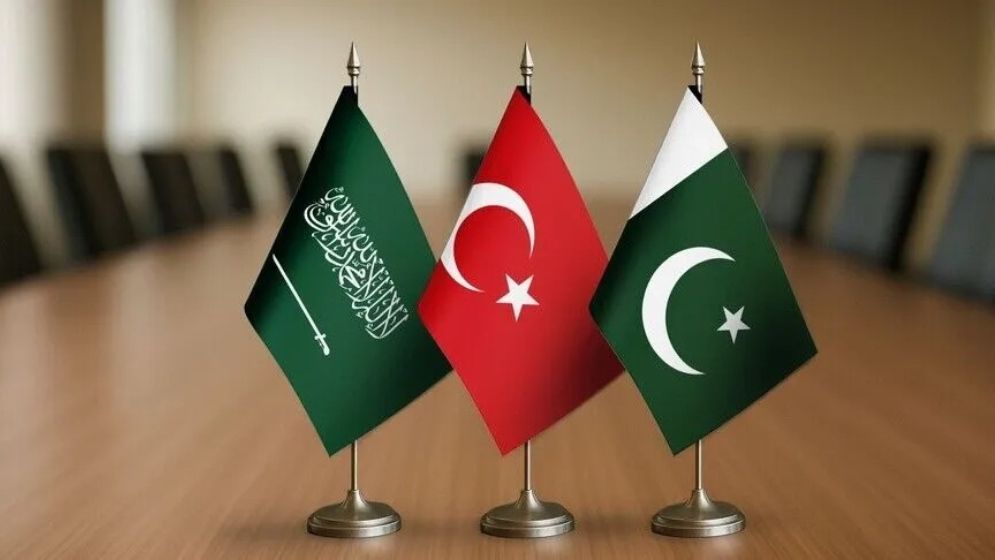
Pakistan, Saudi Arabia and Turkey have recently signed a joint defense agreement known as the “Mecca Defense Pact.” Through this agreement, three influential Muslim-majority countries have come together under a joint defense framework. The new security pact signals a potential shift in the strategic map of the Middle East.
The agreement, signed in the holy city of Mecca on Friday, August 7, states that an attack on any one of the three countries will be considered an attack on all three.
The pact bears similarities to Article 5 of NATO. As a result, it has already created significant geopolitical implications. However, the joint statement did not clearly specify the exact military commitments involved.
For Pakistan, the world’s only nuclear-armed Muslim-majority country, the agreement signals a major shift from its long-standing cautious position as a regional mediator.
Standing alongside Saudi Crown Prince Mohammed bin Salman and Turkish President Recep Tayyip Erdogan, Islamabad is presenting its armed forces as a key component of a potential new security bloc extending across South Asia and the Gulf region.
The agreement could signal a major transformation. As the long-standing regional security system centered around the United States comes under increasing pressure because of war and shifting alliances, Middle Eastern countries are increasingly seeking to take control of their own security. In this context, Pakistan’s nuclear and conventional military capabilities could emerge as a new foundation or pillar of regional security.
The pact comes at a time of unprecedented pressure on the region’s traditional security arrangements.
The war between Iran, the United States and Israel has altered the region’s strategic landscape. Commercial shipping has been severely disrupted along both the Strait of Hormuz and the Red Sea.
A Pakistani security official monitoring developments in the region, speaking to Middle East Eye on condition of anonymity, said, “Preventing further escalation is in the shared economic and security interests of all three countries. Ultimately, this is what compelled them to sign the agreement.”
Disruptions to shipping through the Strait of Hormuz have affected Saudi Arabia’s fuel and fertilizer supplies. The consequences have also been felt by the global economy. Import-dependent Pakistan and Turkey are particularly vulnerable to this crisis.
Security concerns, however, are even more significant. Both Saudi Arabia and Turkey have faced attacks linked to the broader regional conflict. At the same time, Islamabad and Ankara are deeply concerned that instability along their borders with Iran could spill over into their own territories.
Turkey faces another security challenge. There are concerns that if outside powers provide weapons to Iranian Kurdish militias, Turkey’s fragile peace process with the Kurdistan Workers’ Party (PKK) could collapse.
The broader conflict has also activated Iran and its allies in Yemen, particularly the Houthis. They have increased direct attacks on Saudi territory.
For Gulf leaders, the failure of the United States’ long-standing security guarantees to prevent such attacks has raised questions about Washington’s reliability as a security partner. As a result, regional powers are placing greater emphasis on developing their own defense capabilities rather than relying primarily on security guarantees from outside powers.
Former Pakistani ambassador Asif Durrani described the agreement as “the first practical foundation of an emerging regional security architecture.” In his view, it signals a move toward regional countries taking greater responsibility for their own security.
In a post on X, Durrani wrote that if this momentum continues, decades-old conflicts—including the long-running Palestinian issue—could potentially find a path toward resolution through greater regional leadership.
Analysts say the agreement is not an isolated development; rather, it is a continuation of growing cooperation among the three countries over the past several months.
Michael Kugelman, a senior South Asia analyst at the Atlantic Council, described the pact as the “natural outcome” of deepening security ties among the three countries in recent months.
There was already a foundation for this cooperation. In late 2025, Riyadh and Islamabad signed a bilateral mutual defense agreement. Under that arrangement, around 8,000 Pakistani troops, fighter aircraft and air-defense systems were deployed to Saudi Arabia. Turkey, meanwhile, has been supplying both countries with defense equipment on a large scale.
The Agreement Could Also Be Welcomed in Washington
Kugelman wrote on X that the agreement emphasizes building a collective regional deterrence framework focused on Iran. Therefore, Washington may view it positively, as the United States wants to see its key allies take on a greater share of regional security responsibilities.
Military Power as a Path to Economic Support
Analysts say that for Pakistan, the agreement is not merely about geopolitics. It is also deeply connected to the country’s economic vulnerabilities.
For Islamabad, the pact represents a significant shift. In recent months, Pakistan had attempted to portray itself as a diplomatic bridge between the United States and Iran.
In June, Pakistan played an important role in drafting the “Islamabad Memorandum of Understanding” aimed at temporarily reducing regional tensions. But as the conflict subsequently escalated, Pakistan’s neutral position became increasingly constrained. For a government struggling with prolonged inflation and financial difficulties, strategic defense policy is becoming increasingly intertwined with economic necessity.
Historically, Pakistan has used its military strength to secure economic assistance, particularly from the United States and Saudi Arabia.
The new joint defense framework institutionalizes that model to a greater extent. In exchange for military capabilities such as joint training, troop deployments and arms exports, Islamabad could gain access to major Gulf investments, energy-sector benefits and stronger diplomatic support from one of the region’s most powerful countries.
For Riyadh, Pakistan offers the advantage of a large and capable military with decades of experience in warfare and counterterrorism operations. For Islamabad, close security cooperation with Saudi Arabia creates opportunities for investment, financial assistance and stronger economic ties with one of the region’s most influential powers.
The Pakistani security official told Middle East Eye, “In this sense, Pakistan’s military power is becoming not only a strategic asset but also an economic asset.”
Saudi Money, Turkish Technology and Pakistani Military Power
The emerging partnership brings together three distinct forms of strategic strength.
Shahriyar Khan, a senior adviser to Pakistan’s Ministry of Law and Justice and a political analyst, said the arrangement brings together “Saudi Arabia’s economic power, Turkey’s technological innovation and Pakistan’s core military capabilities.”
He told Middle East Eye, “Together, these three countries could build a security partnership whose capabilities extend beyond conventional troop deployments.”
Each country brings complementary capabilities.
Saudi Arabia has enormous financial resources, significant influence in energy markets and a strong position in regional diplomacy. Turkey, which operates NATO’s second-largest military, has an advanced and increasingly self-reliant defense industry, including capabilities in drones, electronic warfare and precision-guided weapons. This is reducing Turkey’s dependence on foreign suppliers. Pakistan, meanwhile, contributes a large, battle-tested military and the Muslim world’s only nuclear deterrent capability.
The Risk of Getting Drawn Into a Conflict
Experts, however, say the agreement also creates significant risks for Pakistan. Iran has already sharply criticized the pact.
Ebrahim Rezaei, a member of Iran’s parliamentary National Security and Foreign Policy Committee, wrote on X that Saudi Arabia should understand that a paper agreement with Turkey and Pakistan cannot guarantee its security, just as relying on the United States for years had failed to provide lasting security.
Iran’s reaction highlights Pakistan’s fundamental dilemma. Becoming more deeply integrated into the Gulf’s defense structure could damage Islamabad’s long-standing cautious and balanced relationship with Tehran.
Analysts warn of the risk of “entrapment”—that is, Pakistan could become involved in a foreign conflict that does not align with its own national interests.
Historically, Pakistan has avoided becoming directly involved in power struggles in the Middle East. In 2015, Pakistan’s parliament rejected a proposal to join the Saudi-led coalition in Yemen because of domestic political and sectarian concerns.
Pakistan has a large Shia population, some members of which regard Iran’s religious leaders as political and religious guides. Therefore, Islamabad will have to ensure that its closer relationship with Saudi Arabia and Turkey is not perceived domestically as an anti-Iran stance. Otherwise, sectarian divisions within the country could intensify.
A “Muslim Security Alliance”?
There is growing discussion over whether the agreement could eventually develop into a broader security alliance involving other Muslim-majority countries.
Muhammad Saeed, a retired senior Pakistani military officer, believes that several other Muslim countries from the Middle East and possibly beyond could eventually join the framework.
He cautioned, however, that military power alone will not guarantee the success of such an alliance.
In a post on X, he wrote that the true collective strength of Muslim countries would not come solely from military capabilities. Rather, cooperation based on long-term investment, knowledge, innovation, discipline, character and tolerance toward sectarian sentiments would be the key source of strength.
The possibility of a stronger and more united security alliance has already raised concerns in Israel.
In February, former Israeli Prime Minister Naftali Bennett explicitly warned against Turkey using Pakistan’s nuclear capabilities to create a “hostile axis” around Israel.
Analysts nevertheless say Pakistan’s status as a nuclear-armed state inevitably changes the strategic calculations surrounding the pact.
For Saudi Arabia, closer defense ties with Islamabad could provide additional deterrence against the Iranian threat. At the same time, Riyadh will have to maintain a balance in its relationship with Israel.
India Will Also Be Affected
The impact of the agreement could extend far beyond the Middle East. For Pakistan, closer relations with Saudi Arabia and Turkey could create a strategic balance vis-à-vis India.
Although Saudi Arabia maintains extensive economic and trade relations with India, the new joint defense framework strengthens Pakistan’s role as a security partner for an important Gulf country.
India’s Ministry of External Affairs has responded cautiously, saying that New Delhi is “closely monitoring developments.” However, Indian national security analysts are becoming increasingly concerned about the agreement.
Kabir Taneja, executive director of the Middle East program at the New Delhi-based Observer Research Foundation, wrote on X that most people would naturally view the development from a Middle Eastern perspective, but its effects would extend to other areas as well—most importantly, Pakistan’s long-standing conflict with India.
Former Indian foreign secretary Kanwal Sibal described the agreement in an X post as “a highly negative development for India’s interests.”
He recommended that India expand its strategic options by strengthening ties with the United Arab Emirates, Israel, Greece, Cyprus and Afghanistan.