

For Bengalis living abroad, migration has never been solely about making a living. Along with their aspirations, they have carried a language, a history, a culture, and a deeply rooted sense of identity. Despite being scattered across continents, their enduring commitment to the Bengali language and its literary and cultural heritage has become one of the greatest strengths of the global Bengali community.
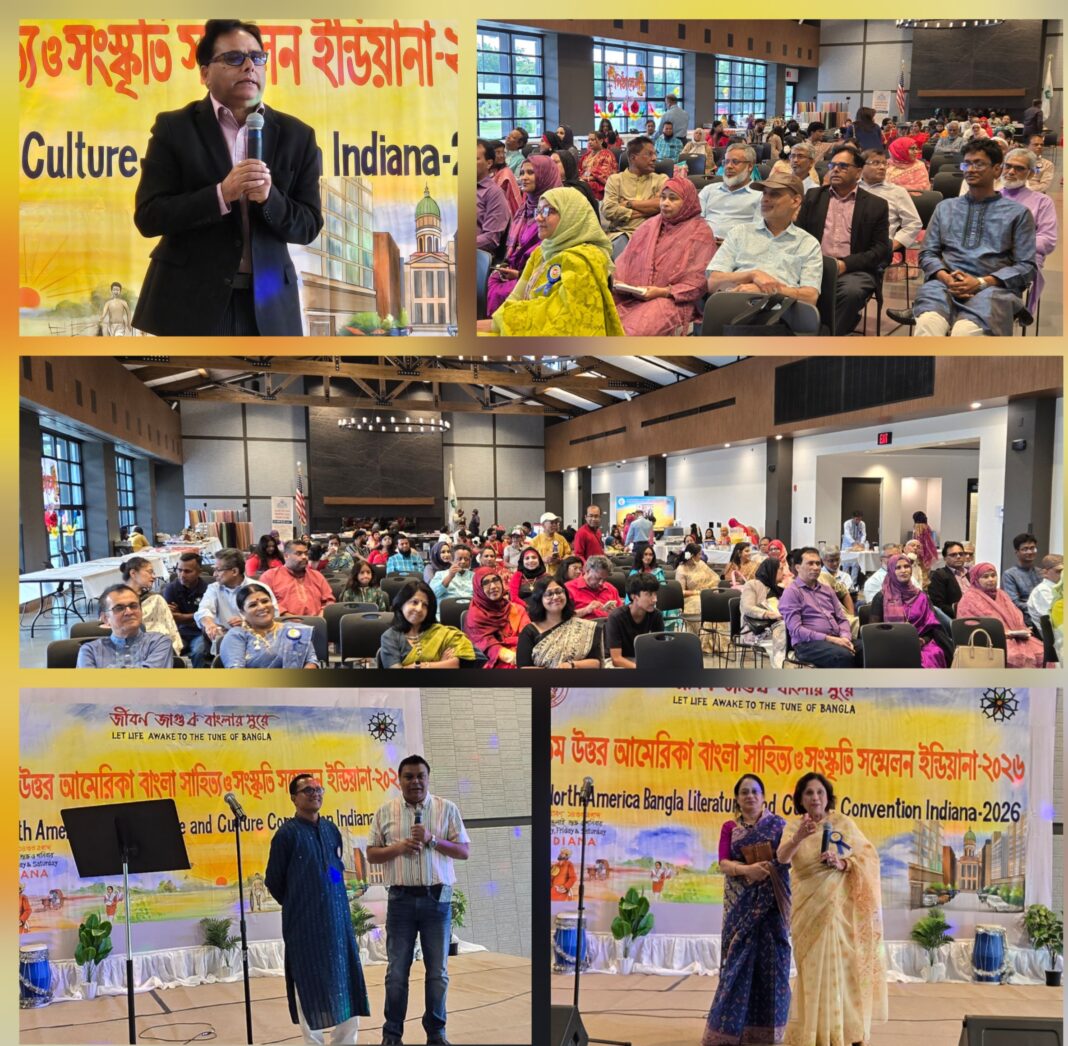
That spirit echoed throughout the 16th North American Bengali Literary and Cultural Conference (NABLCC) 2026, held in Noblesville, Indiana. Speaker after speaker emphasized a shared conviction: wherever Bengalis have settled around the world, they have kept the light of their language and culture burning.
The biennial conference transformed a corner of Indiana into a vibrant celebration of Bengal. Writers, artists, educators, researchers, cultural activists, and lovers of the Bengali language traveled from across North America to gather under one roof. It was more than a cultural festival—it was a reunion with memory, heritage, and identity, where literature, music, art, and history intertwined with the emotions of home.
One of the conference’s most celebrated attractions was the Bengali Book Fair. For the first time in this region of Indiana, the renowned New York-based publishing house Muktadhara participated with an extensive collection of contemporary literature, scholarly works, and classic publications. Visitors crowded the book stalls throughout the event. Muktadhara’s founder, Bishwajit Saha, said that seeing such enthusiasm for Bengali books so far from home renewed his optimism. After nearly four decades of publishing, he remarked, the fair reaffirmed that books remain one of the most cherished connections to Bengali culture.
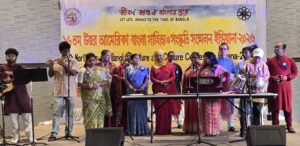
The conference officially opened on Friday afternoon with children’s poetry recitations, a traditional pitha festival, literary discussions, and performances by local artists. The voices of children reciting Bengali poetry, the aroma of homemade traditional delicacies, and the melodies of Bengali songs created an atmosphere that momentarily erased the thousands of miles separating participants from their homeland. For many, it felt as though they had returned to a village in Bangladesh.
Under the leadership of Convener Azad Hossain and Joint Conveners Dilruba Amin Mita and Anjan Roy, the conference was organized with remarkable warmth, professionalism, and attention to detail. Participants expressed sincere appreciation for the countless volunteers whose quiet dedication made such a large-scale literary and cultural gathering possible in the American Midwest.
The distinguished guest list included Indiana Secretary of State Diego Morales; Anindita Kazi, granddaughter of Bangladesh’s National Poet Kazi Nazrul Islam; acclaimed singer Kona; Somnath Ghosh, Consul General of India in Chicago; Munir Chowdhury, Honorary Consul General of Bangladesh in Chicago; cultural personality Dr. Abdur Chowdhury; author and Editor of Prothom Alo North America, Ibrahim Chowdhury; cultural personality Joyshree Barua; author Dr. Mostak Ahmed; educator and author Dr. Shirin Siddiqui; the organization’s founding president Mohammad Alam Panna; businessman and cultural advocate Shah J. Chowdhury; Nandita Gangopadhyay Das; and many other distinguished writers, educators, and cultural figures from across North America.
Addressing the audience, author and Prothom Alo North America Editor Ibrahim Chowdhury said, “It is the Bengali diaspora that has helped build today’s global Bengali community. The next generation will carry the flag of our language and culture even higher.” He added that Bangladesh, born through the sacrifices of the Liberation War, will continue to strengthen its place on the global stage by preserving its language, culture, and rich heritage.
Among those participating in discussions and contributing to the conference’s management during the opening day were Sonia Azad, Leena Ali, Dr. Walker Moazzem, and Likhon Rashid. Greetings were also delivered by Nandita Das Ganguly, Bishwajit Saha, Didarul Alam Panna, Honorary Consul General Munir Chowdhury, journalist Hasanuzzaman Saki, Pinaki Talukdar, and several other distinguished guests.
Another memorable feature of the conference was its exhibition of photography and visual arts, alongside displays of traditional Bangladeshi clothing and jewelry, authentic Bengali cuisine, and interactive spaces where younger generations connected with their cultural roots. Together, these events conveyed a powerful message: Bengali culture in the diaspora is not merely a nostalgic memory—it is a living, evolving way of life.
For several days beneath the peaceful skies of Noblesville, another Bengal seemed to come alive. Through language, literature, music, books, and the warmth of community, the conference demonstrated that geographical distance can never sever one’s connection to the mother tongue. If anything, distance often deepens those roots. For Bengalis around the world, language, literature, and culture remain the enduring foundations of their collective identity.
The conference’s official media partners were Prothom Alo North America, Somoy Television, TBN-24, and DeshiTribune.com.