

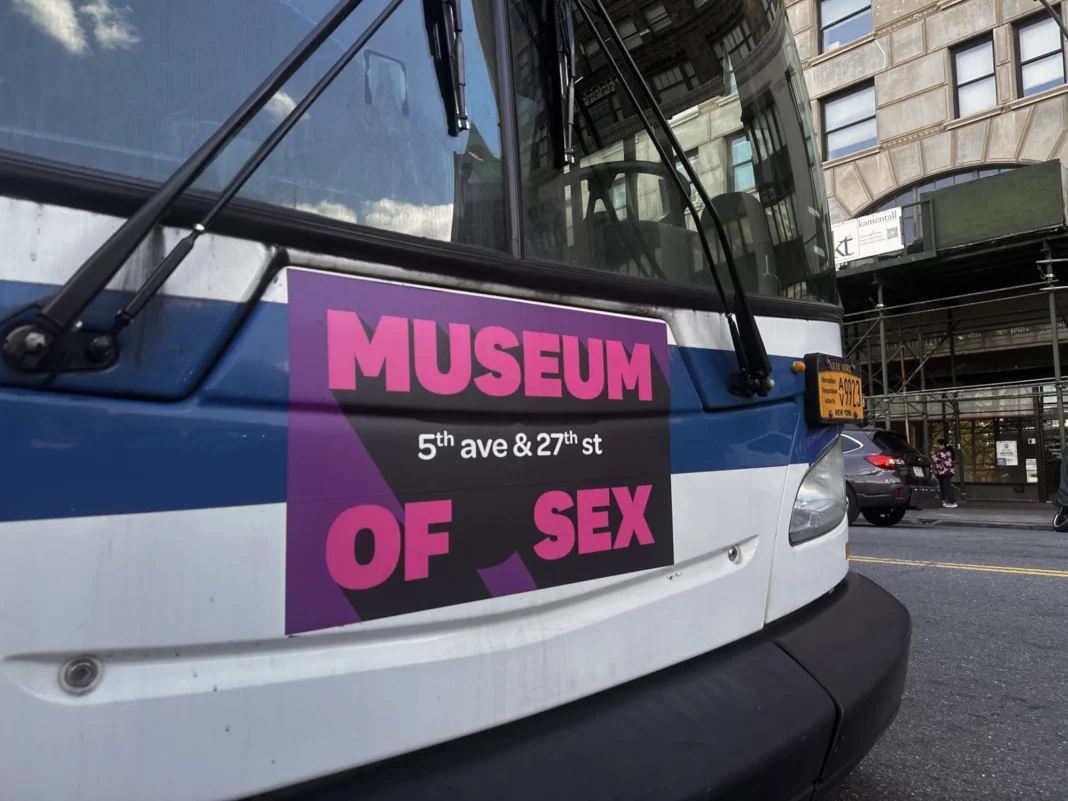
NEW YORK — A growing controversy is unfolding across New York City as thousands of city buses display prominent advertisements for the Museum of Sex, drawing criticism from religious leaders who argue the campaign is inappropriate for children and families.
The dispute reached the monthly board meeting of the Metropolitan Transportation Authority (MTA) on Wednesday, June 25, where Orthodox Jewish community leaders formally urged the agency to remove the advertisements. MTA officials, however, maintain that constitutional free-speech protections limit their ability to intervene.
The advertisements, currently displayed on more than 3,000 buses throughout Manhattan, Brooklyn, Queens, and the Bronx, feature little more than the museum’s name—“Museum of Sex”—and its location. Yet the campaign has generated significant debate over the balance between public morality and freedom of expression.
Founded in 2002 by entrepreneur Daniel Gluck, the Museum of Sex was created to explore the history, evolution, and cultural significance of human sexuality through exhibitions, art, and educational programming.
Located in Manhattan’s Flatiron District, just blocks from the Empire State Building, the institution is the first museum of its kind in the United States.
The museum occupies three floors dedicated to exhibitions on sexuality in history, science, art, and culture, along with four additional floors featuring its permanent interactive attraction, Super Funland: Journey Into the Erotic Carnival.
Over the years, the museum has hosted exhibitions ranging from 2,500 Years of Sexuality in China to The Evolution of American Pin-Up Photography, 1860–1960 and, more recently, Three Centuries of Sex in American Cults and Communes. Its collection includes more than 20,000 artifacts, photographs, artworks, garments, technological innovations, and historical materials. Admission is restricted to visitors 18 and older.
Museum founder Daniel Gluck has long sought to make the institution’s logo part of New York City’s visual landscape. The current campaign reflects that ambition, placing the museum’s name prominently on bus fronts across the city.
For many religious families, however, the advertisements have become a source of frustration.
Speaking before the MTA board, Rabbi Abraham Zimmerman of the Central Rabbinical Congress argued that Orthodox Jewish teachings discourage voluntary exposure to sexually suggestive material.
“We work hard to shield our children and grandchildren from this type of content,” Zimmerman said. “Yet every day these advertisements are placed directly in front of them.”
Rita Friedman, the daughter of Holocaust survivors, echoed those concerns, questioning what messages younger generations receive when such advertising becomes a routine part of public life.
The controversy is not entirely new. In 2018, a similar Museum of Sex advertising campaign prompted complaints from female bus operators who reported being subjected to inappropriate comments from passengers. Following pressure from the Transport Workers Union, the ads were moved from the fronts of buses to less visible locations. That campaign lasted only a month.
MTA Chairman Janno Lieber acknowledged that some bus operators and passengers have experienced uncomfortable situations as a result of the advertisements.
“Some riders are making inappropriate comments to drivers and fellow passengers,” Lieber said.
Nevertheless, he emphasized that the agency cannot act as a censor.
Under the First Amendment, the MTA generally cannot reject advertisements solely because some members of the public find them objectionable. Because the Museum of Sex is legally recognized as an educational and cultural institution, its advertisements are treated as promotions for a cultural venue rather than for adult products or services.
Lieber noted that the MTA had previously asked museum officials to make the institution’s address more prominent in the advertising so riders would clearly understand that the ads referred to a physical museum and not to an activity taking place on the buses themselves.
“I sympathize with those who are concerned,” Lieber said. “But we operate within the framework of the First Amendment.”
Advertising remains a significant, though relatively small, revenue source for the transit agency. The MTA generates approximately $175 million annually from advertising, less than one percent of its roughly $20 billion operating budget. Still, maintaining relationships with
advertisers remains important for the financially challenged transit system.
At its core, the debate reflects a longstanding American tension: the clash between religious and moral values on one hand, and constitutionally protected free expression on the other.
Many New Yorkers, meanwhile, appear largely unfazed by the controversy. Speaking to local media, one commuter offered a simple response: “Honestly, I don’t pay much attention to it.”
For now, the Museum of Sex advertisements remain on New York City’s buses—and so does the debate surrounding them.