

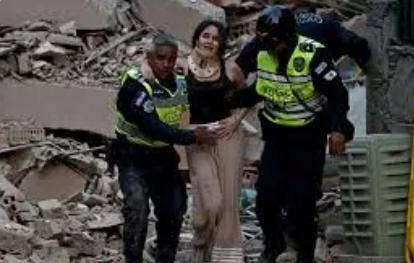
Venezuela was rocked by two powerful earthquakes on Wednesday evening, triggering widespread destruction across the country’s northern coast, collapsing buildings in the capital, and prompting fears that the eventual death toll could reach into the tens of thousands.
The twin quakes struck just 40 seconds apart shortly after 6 p.m. local time, sending terrified residents fleeing into the streets and prompting authorities to declare a nationwide state of emergency.
According to the U.S. Geological Survey (USGS), the first earthquake measured 7.2 in magnitude and was centred near the city of San Felipe, approximately 284 kilometres west of Caracas. A second, even stronger 7.5-magnitude quake struck near Yumare less than a minute later.
The USGS issued its highest-level “Red Alert” for both events, warning that catastrophic casualties and extensive damage were likely. In its preliminary assessment, the agency indicated that fatalities could ultimately range from 10,000 to more than 100,000 people.
“High casualties and extensive damage are probable, and the disaster is likely widespread,” the USGS said in its alert. Such warnings are rare and are typically issued only once or twice a year worldwide.
Acting Venezuelan President Delcy Rodríguez addressed the nation on state television, confirming fatalities and announcing a nationwide emergency declaration. She did not provide a specific death toll, saying rescue operations were still underway and information remained incomplete.
Local officials in one district of Caracas reported at least three confirmed deaths, though authorities cautioned that the figure was expected to rise significantly as emergency crews reached affected areas.
Major damage was reported at Simón Bolívar International Airport, Venezuela’s principal international gateway, forcing officials to suspend operations. In the coastal state of La Guaira, at least 15 buildings reportedly collapsed.
Witnesses described scenes of panic and devastation.
“I couldn’t believe what was happening,” said Heidi Romero, who was working on an upper floor of a shopping centre when the shaking began. “It felt like it would never stop.”
Carmen Guedez, 69, said the tremors intensified rapidly.
“It started slowly, then grew stronger and stronger,” she said. “The windows were moving, and then everything seemed to shake at once.”
Amparo Díaz, who lives on the fourth floor of an apartment building, said she heard a deep roar coming from beneath the ground.
“It felt as if I was floating on water,” she recalled. Part of her kitchen collapsed during the quake, and she planned to spend the night outdoors.
Eighty-year-old Manuel Guevara Barro, who lived through Venezuela’s devastating 1967 earthquake, said this disaster was unlike anything he had previously experienced.
“There is no comparison,” he said. “This was completely different.”
Seismologists say Venezuela’s location along the boundary between the Caribbean and South American tectonic plates makes it particularly vulnerable to earthquakes.
Bashan Wright, a geophysicist at the University of California, explained that Caracas sits atop a deep sedimentary basin that can amplify seismic waves, significantly increasing ground motion and structural damage.
International leaders quickly expressed solidarity with Venezuela.
U.S. President Donald Trump said on social media that he had directed federal agencies to stand ready to assist if requested. Governments across Latin America, including Mexico, Brazil, and Bolivia, also offered support and condolences.
The disaster comes at a particularly fragile moment for Venezuela, which has been struggling with years of economic hardship and political instability. The country’s infrastructure was already under severe strain before the earthquakes struck.
Rescue efforts continued through the night as emergency crews searched collapsed buildings for survivors. Authorities warned that widespread power outages and disruptions to telecommunications networks were hampering efforts to assess the full scale of the disaster.
With many areas still inaccessible and communications severely limited, officials cautioned that the number of dead and injured could rise substantially in the coming days as the extent of the destruction becomes clearer.