

Science plays an extraordinary role in human life. It is one of humanity’s greatest achievements in helping us understand the world and improve the quality of our lives. Throughout history, scientific discoveries have transformed the way we live, work, communicate, and think. The contributions of countless scientists have made our lives
safer, easier, and more comfortable.
One of science’s greatest strengths is its commitment to evidence-based reasoning. It does not accept an idea or theory without proper explanation or verifiable proof. This disciplined approach helps eliminate misconceptions and ensures that knowledge remains reliable and
trustworthy. It is precisely for this reason that science continually corrects itself, evolves, and grows stronger.
Yet, despite living in a society that increasingly relies on scientific evidence and rational thinking, people—including many highly educated individuals—continue to embrace beliefs and practices that cannot be scientifically proven. Traditions, cultural customs, dietary habits, alternative healing methods, social conventions, political views, and religious beliefs are often shaped more by philosophy, heritage, and personal conviction than by scientific evidence.
This reflects an important truth about human nature. While science helps us understand the physical world, people often find meaning, identity, emotional comfort, and a sense of belonging through beliefs that cannot always be measured or tested. These non-scientific beliefs influence our behavior, strengthen communities, and provide emotional reassurance.
They remind us that human life is guided not only by reason and knowledge but also by culture, imagination, and emotion.
With that in mind, I would like to share a philosophical thought of my own. It is not scientifically proven, and I know you may already be wondering where this story is leading. Before I begin, let me simply say that today is Father’s Day.
Today, fathers around the world are celebrating with their children, sharing love, memories, and the experiences of life. Children, too, are spending precious time with their fathers. It is also true, however, that Father’s Day is generally not celebrated with the same level of
emotion, color, or public enthusiasm as Mother’s Day. A mother’s sacrifice and unconditional love for her child are truly beyond comparison.
Still, my little philosophical reflection is offered purely in the spirit of joy—to give fathers a little extra appreciation and perhaps a little more love from their children on Father’s Day. I hope fathers everywhere will enjoy the thought, even though it has no scientific
foundation.
This story dates back nearly ten years.
I was interviewing for a teaching position in New York. After the initial interview, I was asked to deliver a twenty-minute demonstration lecture on Anatomy and Physiology. Coincidentally, it was the day after Father’s Day. The presentation was extremely important because a successful lecture could significantly improve my chances of getting the
job.
The classroom was filled with students, faculty members, the dean, and other academic staff. After finishing my lecture on the female reproductive system, I invited questions from the audience.
A student asked, “Why does a baby cry immediately after birth?”
At first, I was a little surprised because I was certain she already knew the scientific explanation. Then I remembered that Father’s Day had just passed. I thought it would be a perfect opportunity to add a touch of humor to the classroom. After all, a little laughter can make learning more engaging and memorable.
So I began by making one thing clear.
“I am not going to give you the scientific answer,” I said. “But if you’ll allow me to share a philosophical thought, I’d be happy to do so.”
Everyone agreed.
Then I answered:
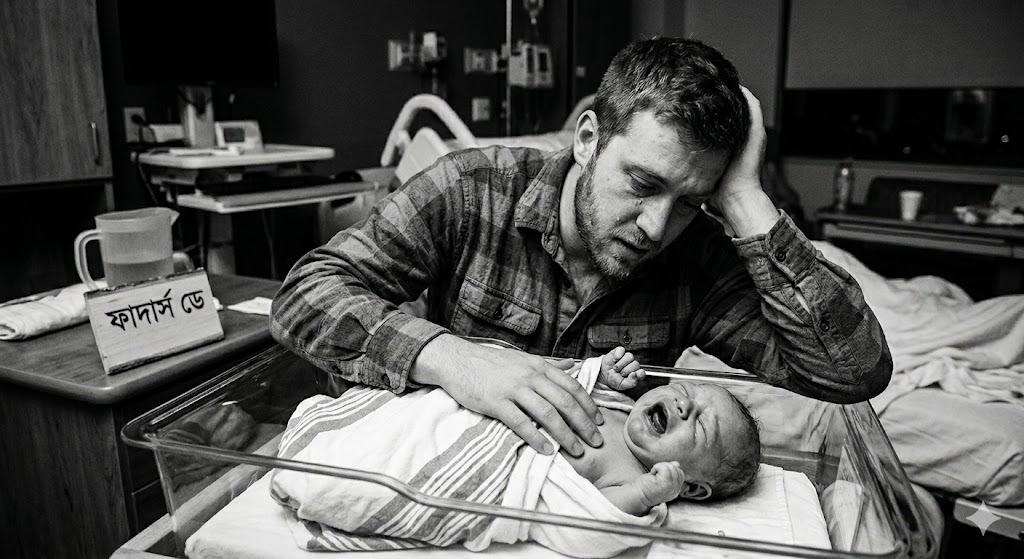
“A newborn cries because it is looking for its father.”
For nine months, the baby lives safely inside its mother’s womb—the safest place on Earth. But after spending so much time there, the baby grows impatient. It wants to meet its father. So it begins kicking, eager to come into the world.
Then the baby is finally born.
But instead of seeing its father, it finds itself surrounded by strangers dressed in white coats. It looks around, searching for the one person it has been waiting to meet—but cannot find him.
And so, the baby begins to cry.
The entire room erupted in laughter. Even the professors thoroughly enjoyed the answer.
Later, someone asked me why I had chosen such a philosophical response.
I smiled and reminded them that we had just celebrated Father’s Day, and I simply wanted to wish all the men in the room a Happy Father’s Day in a memorable way.
Then I invited everyone to say, together, “Happy Father’s Day.”
For a brief moment, we celebrated the love, sacrifice, responsibility, and lifelong dedication of fathers everywhere.
Today, as Father’s Day comes around once again, I find myself remembering that interview and the laughter it created. Through this little philosophical reflection, perhaps we can all offer fathers a smile by imagining that a newborn’s very first cry is simply the
beginning of its search for its father.
To all fathers around the world, Happy Father’s Day.
Thank you for your lifelong love, your selfless sacrifices, your quiet strength, and your unwavering commitment to your children. You deserve our deepest respect and heartfelt appreciation—not only today, but every day.
Long Island, New York, June 21, 2026