

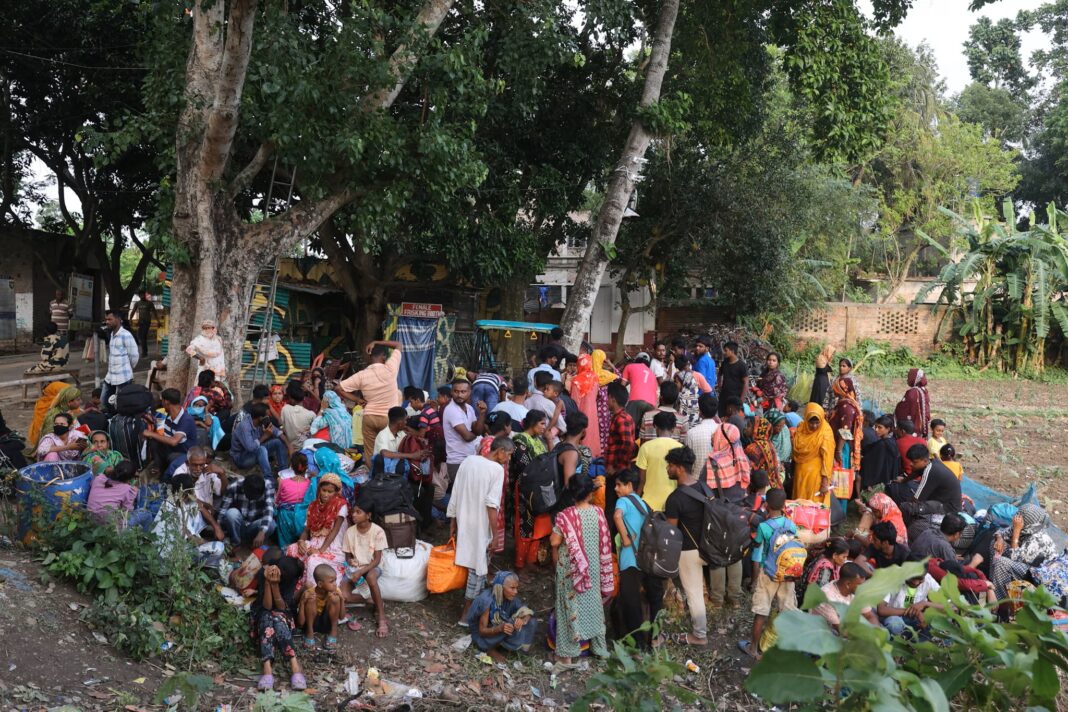
An unusual scene has unfolded over the past several days at the Hakimpur border checkpoint in North 24 Parganas district of West Bengal. Around 90 kilometers from Kolkata and close to the Bangladesh border, nearly 300 men, women, and children are sitting huddled under the scorching sun in a small open field, clutching small bags containing all their belongings. They have heard that entry into Bangladesh is possible through this route, and since Sunday they have been arriving in groups — some in the middle of the night, others before dawn.
Under the tin roof of a tea stall, police officials are recording each person’s name and Bangladeshi address in a register. Most of them do not possess valid documents to stay in India, though many carry proof of Bangladeshi citizenship.
After the Bharatiya Janata Party (BJP) secured a majority in the recent West Bengal Assembly elections, a new government led by Suvendu Adhikari came to power. In line with its election promise, the government adopted a three-step policy of “Detect, Delete and Deport.” As part of this policy, two detention camps have already been opened in Malda and Murshidabad districts, where 16 people are currently being held.
Earlier, during the Special Intensive Revision (SIR) drive, many people had also returned to Bangladesh through this route. On Tuesday, Chief Minister Suvendu Adhikari addressed those heading toward the border, saying: “Run quickly, otherwise the government will do what it has to do.” The remark has further intensified fear among those already living in panic.
Thirty-nine-year-old Khukumoni Bibi is standing at the border with her husband Musharraf Biswas and their four children. She said they had been living in Kolkata’s New Town area for the past five years. Her husband worked as a garbage collector, while she worked as a domestic helper. Originally from Satkhira district in Bangladesh, she said, “A few days ago our landlord asked us to leave. Then we heard about the detention camps. So we decided to leave everything behind and return. My four children studied in schools here. Now we have to start over again.”
Among the crowd are four men who had been earning their livelihoods as construction workers in Kerala. Fahim Malida, 30, said they crossed into India eight months ago from Kushtia district in Bangladesh through a dried-up river route in Jalangi, Murshidabad. They had chosen a time when BSF guards were changing shifts. Each of them paid brokers 7,000 Indian rupees to cross. In Kerala, they earned around 1,000 rupees a day, while in Bangladesh they could barely find work one or two days a week for about 500 taka. Now, on their way back, they have had to pay another 10,000 rupees each to Indian brokers.
Motleb Hossain, 30, said their problems began during the election period. Landlords started asking for Aadhaar cards, which they did not have. “Even if we manage to enter Bangladesh, we don’t know how we’ll reach home or what will happen next,” he said.
Mohammad Sadeq, 40, had been living for 15 years in a slum in Ultadanga, Kolkata. He and his wife both worked as sanitation workers while raising their three daughters. But three days ago, police and others demolished their shanty home. “We are scared. We do not want our children to go through this harassment,” he said.
Aleya Bibi, 45, and her husband Abdul Hasan, 50, had lived in New Town for 15 years with their two children. Hasan drove a cycle van while Aleya worked as a domestic worker. During the SIR drive they stayed despite lacking voter cards or Aadhaar documents. But now, under pressure from both the new government atmosphere and their landlord, they feel compelled to leave. “After so many years, going back with children is not easy, but we have no choice,” she said.
At the Hakimpur checkpoint, BSF personnel have barricaded roads and are searching vehicles thoroughly. A heavy police presence has also been deployed. BSF officials, speaking anonymously, said biometric data is being collected from everyone, and anyone suspected of criminal or extremist links is being handed over to police.
A senior BSF officer said, “People are being allowed to leave only after proper documentation, biometric checks and verification. They do not possess valid Indian documents, but they are showing papers proving residence in Bangladesh.” Previously, only passport holders used this checkpoint. However, since the SIR drive began last November, large numbers of people have started crossing through this route. Authorities have refused to disclose how many people have already crossed over.
Varun Das, who owns a tea stall near the checkpoint, said, “During the SIR drive too, Bangladeshis returned through this area in the same way. Since Sunday, people have again started arriving with luggage.” His simple observation reflects the depth of the situation — this is not an isolated incident, but another wave of an ongoing humanitarian crisis.
Nearly everyone waiting at Hakimpur shares the same story: years of hard labor in India, raising children, sending them to school, and then suddenly uprooting their lives to step into an uncertain future. Behind them lie memories of half a lifetime; ahead of them, an unknown road.
Behind the label of “illegal infiltrators” are people who crossed borders mainly in search of work and survival. Their departure raises not only questions about law and immigration policy, but also deeper humanitarian questions: are these crossings simply “illegal acts,” or are they rooted in poverty, inequality, and the harsh realities of economic survival?
For now, the families sitting under the blazing sun at Hakimpur do not know what awaits them once they enter Bangladesh. As Motleb Hossain put it: “Even if we get into Bangladesh, we don’t know how we’ll reach home or what will happen.” That uncertainty is now their only companion.
(Source: The Indian Express)