

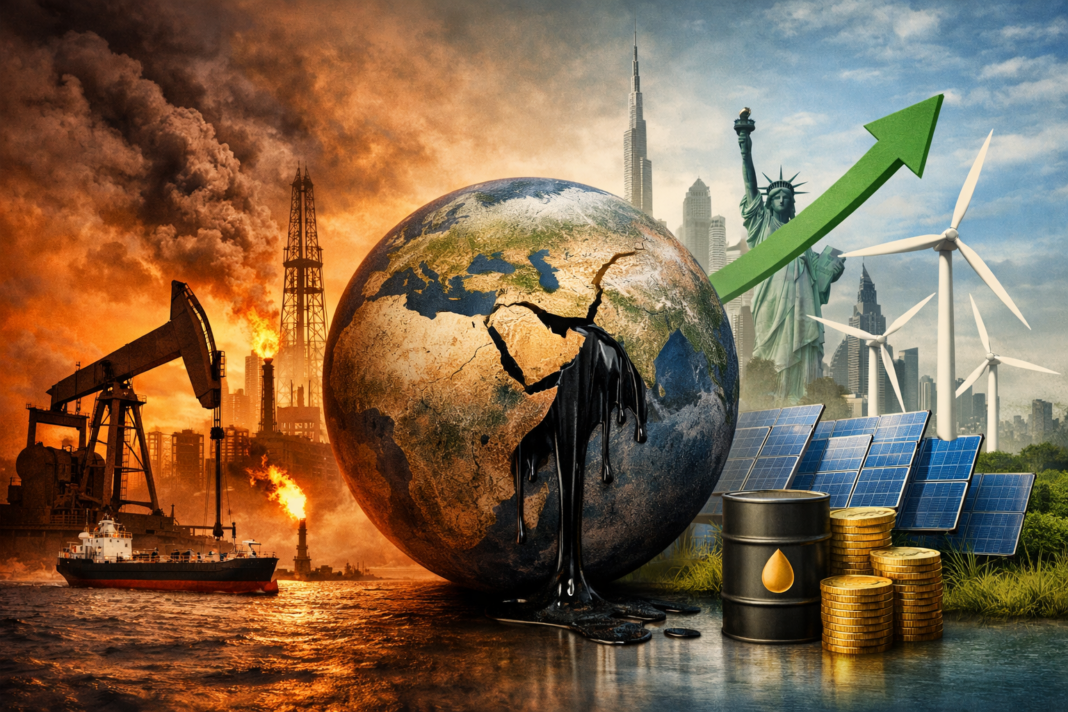
The global oil market is unlikely to return to its previous state even if the conflict with Iran subsides — a reality that is becoming increasingly clear. In a recent analysis published in the New York Post, Elaine Dezenski, Senior Director at the Foundation for Defense of Democracies, outlines how the conflict is reshaping global energy structures, geopolitics, and the long-term strategic position of the United States.
One of the most significant shifts centers on the Strait of Hormuz. Repeated attacks on Gulf ports have pushed Saudi Arabia and the United Arab Emirates to accelerate efforts to develop alternative routes. Saudi Arabia’s East-West pipeline and Abu Dhabi’s crude oil pipeline already allow shipments to bypass the Strait by reaching the Red Sea, and expansion plans are under consideration. At the same time, the proposed India–Middle East–Europe Economic Corridor (IMEC) is being discussed as a long-term solution to transport Gulf energy to India and Europe without relying on Hormuz. Analysts believe that even after the conflict, investments in these alternatives will continue, reducing the Strait’s strategic leverage in future crises.
Gulf countries are also being forced to recalibrate their positions. Dubai and the UAE have long served as hubs for Iran’s shadow banking network. According to the analysis, around 70 percent of Iran’s financial flows in 2024 passed through opaque companies based in the UAE. Under increasing pressure from Washington, the UAE has signalled willingness to tighten controls, including potential asset seizures and closing financial loopholes that have enabled Iranian transactions.
For the United States, the crisis has created an unexpected opportunity. Disruptions in Hormuz have threatened oil supplies to key Asian economies — Japan relies on the route for about 90 percent of its oil, South Korea around 70 percent, and India roughly one-third. Taiwan’s critical semiconductor industry is also exposed to supply risks. In this environment, the U.S. is emerging as a key alternative supplier, with crude oil exports reportedly reaching a record five million barrels per day. Analysts suggest this could translate into long-term gains for U.S. oil and liquefied natural gas markets.
China, meanwhile, faces mounting challenges. In recent years, it has purchased roughly 90 percent of Iran’s oil exports, while reportedly providing Tehran with materials and technologies linked to missile development and satellite systems. The U.S. Treasury is now considering sanctions against Chinese and Hong Kong-based financial institutions accused of facilitating Iranian transactions, potentially escalating economic tensions further.
Russia’s position is also under pressure. While higher oil prices initially benefit Moscow, the broader geopolitical picture is less favorable. Following setbacks in Syria and increasing pressure on Iran, two of Russia’s key regional allies are weakening. Analysts argue that similar strategies used against Iran — including targeting shadow tanker fleets and financial networks — could be applied to Russia in the future.
Finally, Iran’s network of proxy groups has taken a significant hit. U.S. and Israeli strikes have disrupted sectors of Iran’s economy that helped fund groups like Hamas, Hezbollah, and the Houthis. Rebuilding these capabilities could take years, if not decades. However, analysts caution that these groups are not solely dependent on Iran; they also generate funding through organized crime, extortion, and illicit activities worldwide. As a result, policymakers are being warned not to equate a weakened Iran with a defeated one.
Overall, the conflict has triggered structural changes that may redefine global energy flows and geopolitical alignments for years to come.