

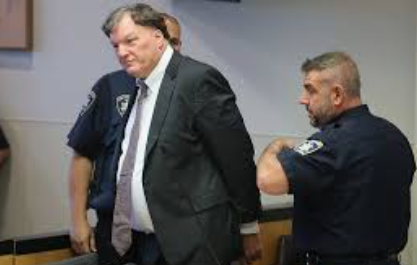
April 8, 2026 | Riverhead, New York
From the outside, Rex Heuermann looked like any other man. A 62-year-old architect from the quiet suburb of Massapequa Park on Long Island, a family man, a neighbor who nodded hello. But on Wednesday, inside a packed Suffolk County courtroom, that carefully constructed facade collapsed forever. Standing before the judge, Heuermann pleaded guilty
to seven murders — and then quietly admitted he had killed an eighth, stretching back to 1996 across eighteen unbroken years of secret carnage.
The crimes, known as the Gilgo Beach killings, had haunted America for over a decade. In 2010, police searching Long Island’s South Shore discovered human remains scattered across the scrubland near Ocean Parkway — bodies wrapped in burlap, victims strangled, some dismembered.
Most of the women were sex workers and young mothers who had turned to extra work to support their children. Heuermann contacted them using burner phones, lured them to isolated locations, and disposed of their remains miles from his home — close enough, investigators would later realize, to be chilling.
The investigation stalled for years. A documentary was made. Netflix released a film. The world watched, discussed and moved on. But the killer remained free, going to work each morning, coming home each evening, living among the very people hunting him.
In 2022, a newly formed Gilgo Beach Homicide Investigation Task Force took a fresh look. A single witness account from 2010 described a pickup truck near the scene when one victim disappeared. Detectives ran the vehicle registration and landed on one name — Rex Heuermann. From there, more than 300 subpoenas and search warrants followed. Billing records from burner phones placed him in contact with victims just before they history revealed an obsessive interest in violent pornography and — disturbingly — the Gilgo Beach investigation itself. He had been watching his own manhunt unfold.
But to make the case airtight, investigators needed his DNA. So they followed him. Day after day, a surveillance team shadowed Heuermann through Manhattan, where he worked. Then one afternoon, he finished his lunch, tossed a box of leftover pizza crusts into a sidewalk trash can and walked away. Detectives moved in immediately, retrieved the box and rushed it to the crime lab. The DNA lifted from the crust matched a male hair found on the burlap used to restrain one of his victims. In July 2023, Heuermann was arrested.
What investigators found inside his home was the stuff of nightmares. A secret vault in the basement contained 279 weapons. On his computer sat what prosecutors described as a killing “blueprint” — detailed checklists with reminders to limit noise, clean the bodies and destroy evidence. A methodical, cold-blooded architecture of murder, built by a
man who designed buildings for a living.
In court on Wednesday, Suffolk County District Attorney Ray Tierney did not mince words. “This defendant walked among us play-acting as a normal suburban dad,” he said, “when in reality, all along, he was obsessively targeting innocent women for death. He thought that by killing them, he could silence them forever. He was wrong.”
For the families, Wednesday brought something they had waited years, in some cases nearly two decades, to feel. Elizabeth Baczkiel, whose daughter Jessica Taylor was among the victims, said the guilty plea took “a big chunk of stress” off her family. Missy Cann, whose sister Maureen Brainard-Barnes was killed, said through tears that she had spent
nineteen years living “in the space between heartbreak and hope.” That space, at last, has closed.
Heuermann will be sentenced in June to life in prison with no possibility of parole. A discarded pizza crust brought him there. And eight women, who were silenced one by one over eighteen years, will finally be heard.