

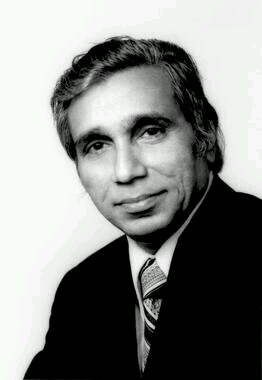
Before Fazlur Rahman Khan, the skyscraper had hit a wall.
It was 1931 when New York’s Empire State Building rose 381 metres into the sky and became the tallest structure on Earth. For over four decades, nothing came close. Not because architects lacked ambition — but because the science simply didn’t allow it. Buildings of that scale required staggering amounts of steel just to stay upright, making them dangerously expensive and structurally risky. The taller you built, the more steel you buried inside — and the more steel you buried inside, the more the numbers stopped making sense.
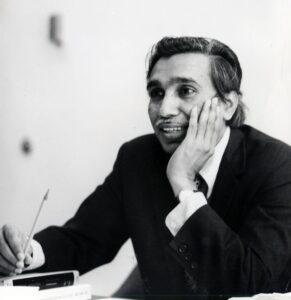
That was the world Fazlur Rahman Khan walked into. And he changed it forever. Born in 1929 in Dhaka — then part of British India, now the capital of Bangladesh — Khan showed extraordinary promise from childhood. He studied civil engineering and, in 1952, won a scholarship to the University of Illinois, Chicago. It was a city that would become his canvas.

The Invention That Changed Everything Khan’s breakthrough was deceptively elegant.
Instead of reinforcing a skyscraper from the inside with heavy steel columns, he proposed
building the strength into the outer skin of the building itself — a system of interconnected vertical tubes forming the exterior frame. This “tubular structure” created a natural rigidity against wind, earthquakes and gravity, while freeing up vast open space inside the floors.
It was, as engineers later described it, a stroke of pure genius.

His first major test was Chicago’s DeWitt-Chestnut Building, followed by the iconic John Hancock Centre in 1968, at the time the world’s second-tallest building. The numbers told the real story: where the Empire State Building required 206kg of steel per square metre to stand, the John Hancock Center needed just 145kg. Less steel. Taller building.

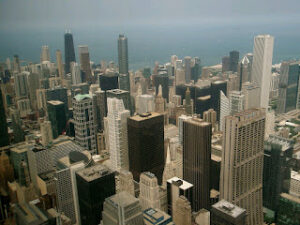
Safer structure. A revolution in a single design. The Buildings That Defined a Century In 1973, Khan’s Sears Tower — now renamed the Willis Tower — pierced the Chicago sky at 442 metres and 108 storeys, overtaking the World Trade Center to become the tallest building on Earth. It held that title for 24 remarkable years.
But his influence did not stop there. When engineers designed Kuala Lumpur’s Petronas Towers, Taipei’s Taipei 101, and Dubai’s Burj Khalifa — the current tallest building on Earth at 828 metres — each one reached for the sky using a direct descendant of the tube structure Khan invented in Chicago.
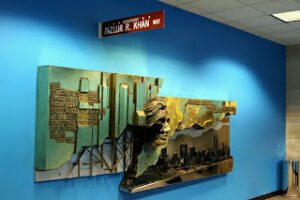
The Telegraph, when the Burj Khalifa opened in 2010, called it “the ultimate expression of his audacious, lightweight design philosophy” and credited Khan with having “changed both the economics and the morphology of supertall buildings.”
More Than an Engineer Khan was not only a structural visionary. He was among the first engineers in the world to use computer-aided design (CAD) to model buildings — decades before it became standard practice. He also designed the Hajj Terminal at King Abdulaziz International Airport in Jeddah, one of the largest roof structures ever built, and provided humanitarian support during Bangladesh’s War of Independence in 1971.
In 2009, President Barack Obama named Khan as an example of the historic contributions of Muslims to American life and civilisation.
When he was named Construction’s Man of the Year, Khan reflected: “The technical man must not be lost in his own technology. He must be able to appreciate life, and life is art, drama, music and, most importantly, people.”
He died in 1982, aged just 52. He never saw the full scale of the world he had built.
Bangladesh’s Greatest Gift to the World Google honoured Khan with a Doodle on what would have been his 88th birthday — yet in Bangladesh, the country he came from, millions have never heard his name. The Council on Tall Buildings and Urban Habitat
has since established the Fazlur R. Khan Lifetime Achievement Medal in his honour — the highest recognition in the field of tall building design.

Every time you look up at a supertall skyscraper, you are looking at his life’s work. The skylines of New York, Dubai, Kuala Lumpur, Taipei and Chicago are, in no small part, the skylines of a boy from Dhaka.
( SEO / TAGS: Fazlur Rahman Khan, Bangladesh, skyscraper, tubular structure, Willis Tower, Burj Khalifa, Bangladeshi engineer, structural engineering, Google Doodle, pride of Bangladesh )