
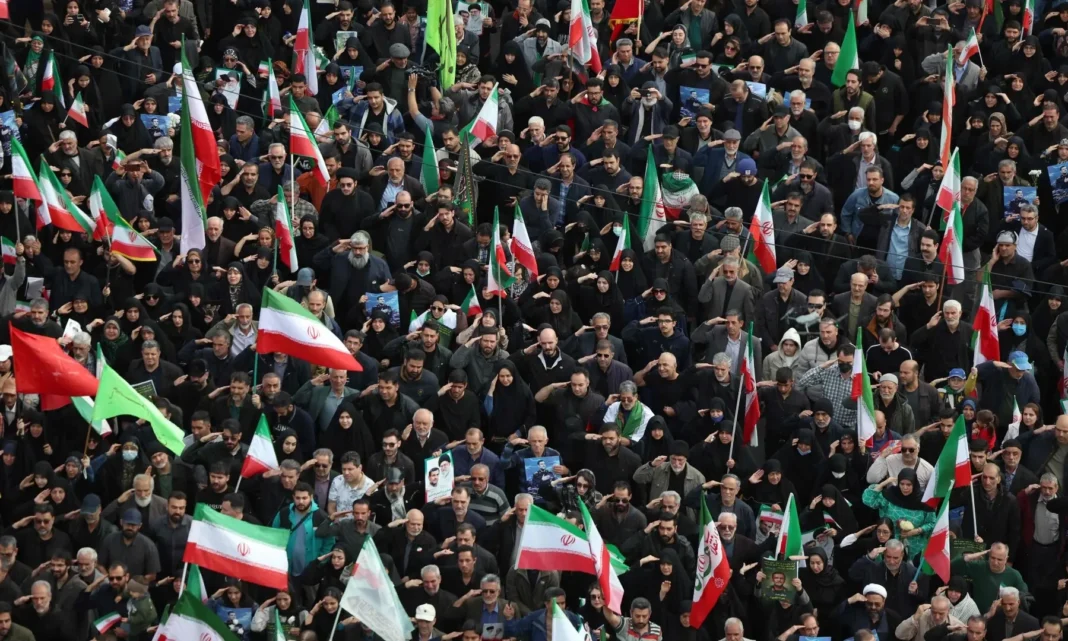
A boy raises his fist while standing atop a giant Iranian flag during the funeral of Alireza Tangsiri, commander of the IRGC Navy, and others killed in US-Israeli strikes on Iran, at Enghelab Square, Tehran, April 1, 2026.
Photo credit: AFP / Agence France-Presse WASHINGTON / TEHRAN — With a war-ending deadline ticking down to its final hours, the United States, Iran and a coalition of regional
mediators are locked in a desperate, last-ditch effort to hammer out a 45-day ceasefire that could, for the first time since February, offer a path out of one of the most perilous conflicts in modern Middle Eastern history — but the window is closing fast.
Citing four senior US, Israeli and regional sources with direct knowledge of the talks, Axios reported Sunday that negotiators are circulating a two-phase framework. Under phase one, all hostilities would cease for 45 days — a window diplomats hope to use to negotiate a
comprehensive, permanent end to the six-week war. Phase two would produce that final settlement. The ceasefire period could be extended should negotiations require additional time, one of the sources confirmed.
“The next 48 hours are the last opportunity to reach a deal and prevent massive destruction.” — Regional mediator, cited by Axios The diplomatic push comes as US President Donald Trump has pushed his ultimatum deadline forward to Tuesday, April 8 at 8:00 p.m. Eastern Time — the third extension in a series of rolling deadlines — after first
threatening that Iran must reopen the Strait of Hormuz or face devastating strikes on civilian energy infrastructure. Trump has said the US is in “deep negotiations” with Tehran, telling Axios that a deal is reachable before time expires. Yet the same sources described the probability of reaching even a partial agreement in the next 48 hours as “slim.”
Pakistan, Egypt and Turkey at the Centre of Mediation Negotiations are being conducted through Pakistani, Egyptian and Turkish intermediaries, alongside informal direct text message exchanges between Trump’s special envoy Steve Witkoff and Iranian Foreign Minister Abbas Araghchi. Pakistan’s army chief, Field Marshal Asim Munir, has been in
contact “all night long” with US Vice President JD Vance, Witkoff and Araghchi, a Reuters source confirmed — underscoring the feverish, round-the-clock nature of the diplomacy.
A framework tentatively dubbed the “Islamabad Accord” has already been exchanged with both Washington and Tehran. Under the outline, a ceasefire would take effect immediately, reopening the critical Strait of Hormuz waterway, with 15 to 20 days allotted to finalise a broader settlement — followed by in-person talks in Islamabad. Iran, however, has pushed back sharply, insisting it “will not accept deadlines or pressure” and will not reopen the strait in exchange for what it characterises as a merely temporary truce.
The Stakes: Catastrophe on Both Ends Mediators have privately told Iranian officials there is no room left for further manoeuvring, and that the coming two days represent the only
remaining chance to avoid a dramatic and potentially catastrophic escalation. Two sources with direct knowledge told Axios that a US-Israeli bombing plan targeting Iran’s energy facilities is “ready.” If executed, the resulting crisis could trigger Iranian retaliatory strikes against oil and water infrastructure across the Gulf states — sending shockwaves through global energy markets already rattled by weeks of war.
Brent crude futures surged 2.1 per cent to $114.37 a barrel on Monday, with diesel prices jumping 5.7 per cent to their highest since the war began. Oil has climbed over 108 per cent since hostilities erupted on February 26.
Iran’s leaders have been uncompromising in public. The Islamic Revolutionary Guards Corps (IRGC) Navy declared Sunday that the Strait of Hormuz “will never return to its former state, especially for America and Israel,” and stated it was completing operational preparations for a “new order” in the Persian Gulf — a pointed signal that Tehran views
control of the strategic waterway as a permanent, non-negotiable lever.
Meanwhile, Iranian officials told mediators privately they refuse to be drawn into what they describe as a “Gaza or Lebanon situation” — a ceasefire that exists on paper while the US and Israel reserve the right to resume strikes at will.
Two Issues That May Break the Deal Sources say mediators believe the two most contentious issues — the full reopening of the Strait of Hormuz and the fate of Iran’s highly enriched uranium stockpile — can only be resolved as part of a final agreement, not a temporary ceasefire. Tehran has made clear it will not fully surrender, either as part of a 45-day pause. Negotiators are instead working on partial “confidence-building measures”: incremental steps Iran could take on both fronts in exchange for US guarantees that the
ceasefire would not be exploited as a tactical interlude before renewed bombardment.
Trump, meanwhile, has signalled a willingness to deal. “There is a chance of a deal,” he told Fox News, while warning that ihttps://gator4097.hostgator.com:2096/cpsess8166982137/3rdparty/roundcube/? task=mail&_action=compose&_id=163519205569d409d873e1f#f talks collapse, the US is prepared to “take over the oil.” Whether that dual posture of open hand and clenched fist will be enough to bring Tehran off its hard line remains the defining question of the next 48
hours.