

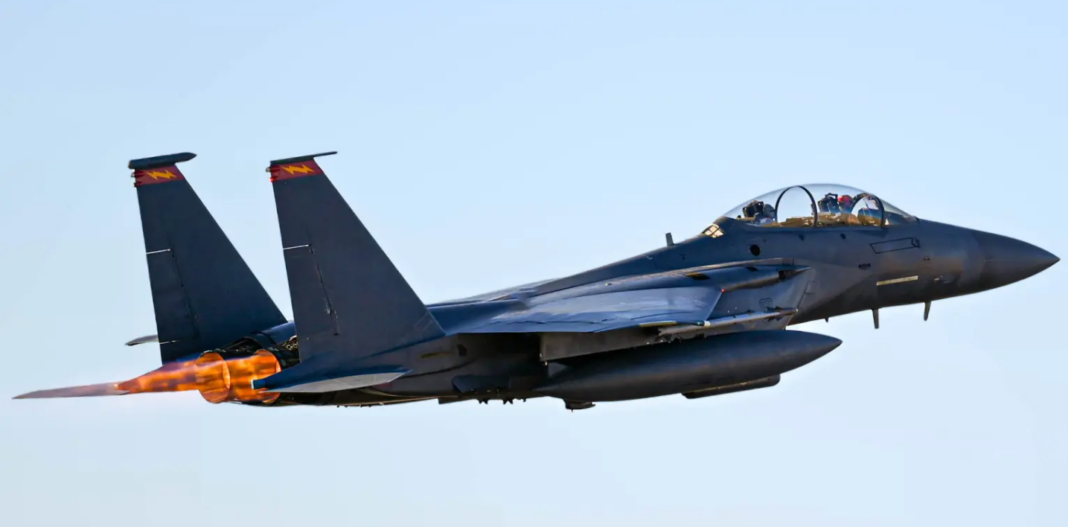
Friday, April 4, 2026. Picture the moment. An American F-15E fighter jet screaming through Iranian airspace, engines roaring, cutting across a hostile sky. Then, without warning, an explosion. Fire. And then only the fall. The pilot ejected and descended by parachute, but the weapons officer — the colonel seated behind him — was now alone on enemy ground.
Seriously wounded. Iranian fighters are closing in from every direction.
And hanging over his head was a bounty of 60,000 dollars for anyone who could deliver him into enemy hands.
What happened next would put any Hollywood screenplay to shame.
Wounded, armed with nothing but a single pistol, the colonel began an impossible journey. Across the savage, unforgiving terrain of Iran’s Zagros Mountain range, he climbed up and further up. Rising more than 7,000 feet above sea level, covering well over a mile of brutal mountain ground, he found what he was looking for: a narrow crevice in the rock face. There he hid, motionless, for 36 consecutive hours. His body was torn and bleeding. Every breath a struggle. But his will is unbroken.
Outside, a terrifying human hunt was underway. Iranian state television broadcast footage of the downed aircraft, whipping the public into a frenzy and urging ordinary citizens to find the American and turn him in. President Trump later told Axios that thousands of people had gone out searching for him, describing them in characteristically blunt terms. Along the mountain trails, Iranian tribal fighters and bounty hunters combed the landscape looking for the wounded man who lay somewhere in the silence of the rocks, perfectly still, waiting.
But Washington was not standing still either. CIA operatives and US military officials managed to track the colonel’s equipment and pinpoint his location. The problem, however, was uncertainty — was the signal genuine, or had the Iranians set a trap to lure more American forces into a killing ground? The Trump administration did not dismiss that fear quickly. Every piece of intelligence was verified with painstaking care before anyone moved.
Then the CIA made a masterstroke. Deliberate disinformation was fed into Iranian channels — a false story that the American soldier had already been rescued and was being driven out of Iran by vehicle. A portion of the hunters, confused and misled, shifted their focus. And in that opening, the real operation began.
On Sunday, local time, the colonel himself sent out an emergency beacon signal from that mountain crevice. Over the radio, he transmitted a brief, quiet message — “God is good.” U.S. Defence Secretary Pete Hegseth later posted those same words on social media the moment the rescue was confirmed successful. Trump told Axios that hearing the phrase over the radio had initially given him pause — because the words, he said, sounded something like the Islamic phrase “Allahu Akbar,” meaning God is Great.
What followed was, in every sense, a war within a war. The rescue operation was launched in broad daylight — a decision that speaks to both the urgency and the audacity of the mission. Dozens of warplanes and MQ-9 Reaper drones formed a protective aerial perimeter over the extraction zone. Any Iranian fighter or vehicle that came within two
miles of the rescue team was to be destroyed immediately, without hesitation. On the ground were 100 Special Operations forces led by Navy SEAL Team 6, with Delta Force commandos and Army Rangers standing by in reserve. US special operations troops also engaged in direct skirmishes with local tribesmen during the hunt.
Then, at the very last moment, the mission hit an unexpected crisis. Two American aircraft positioned south of the city of Isfahan became stuck, grounded, and unable to take off. Three additional aircraft had to be dispatched urgently to extract the stranded forces. And those two disabled planes? They were deliberately destroyed by American forces on the spot, rather than risk them falling into Iranian hands. Iran later released photographs of the wreckage, claiming the destroyed equipment represented nearly 200 million dollars in military assets.
In the end, after 36 hours of what can only be described as a living nightmare, the colonel was successfully extracted. He has been flown to Kuwait for medical treatment. His identity has not been publicly released, and the full extent of his injuries has not been disclosed.
But he is alive. Right now, that is the only thing that matters.
President Trump has framed the rescue as a story of extraordinary heroism and called a press conference at the Oval Office on Monday with senior military officials to address the successful operation. But beyond the remarkable drama of one man’s survival, a far larger and more troubling question hangs in the air — where exactly is the conflict between the United States and Iran heading? A fighter jet shot down, hundreds of millions of dollars in military hardware destroyed, and a colonel huddled alone in an enemy mountain with a pistol for 36 hours before being pulled to safety — this single episode tells you everything
about how dangerous and how volatile the situation between these two nations has truly become.