

By Ibrahim Chowdhury Khokon
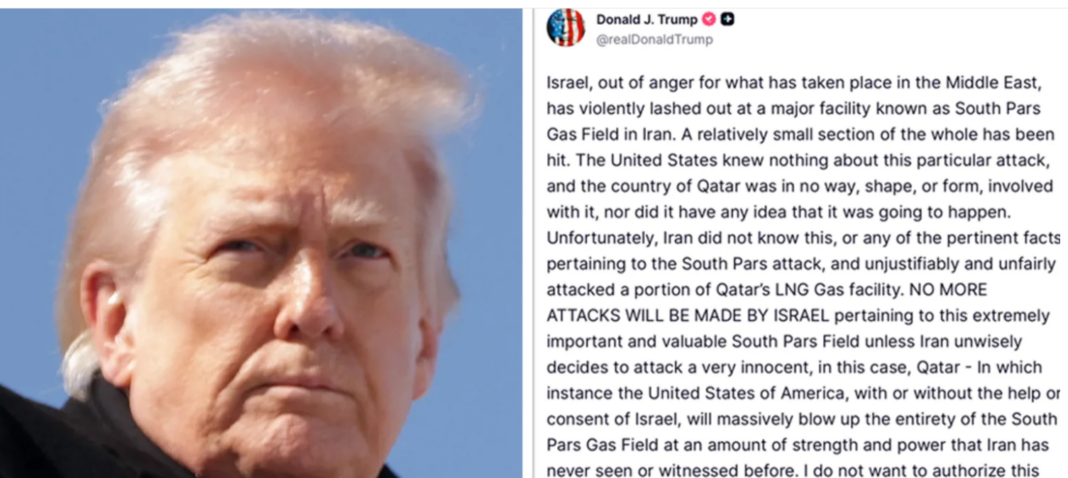
U.S. President Donald Trump has issued a strongly worded response following recent attacks on the South Pars gas field, the world’s largest natural gas reserve jointly shared by Iran and Qatar. On Wednesday, Israel struck Iran’s section of the South Pars field, prompting Tehran to retaliate by targeting Qatar’s Ras Laffan industrial area. The escalation has shaken global energy markets and heightened regional tensions. In a lengthy post on his Truth Social platform, Trump claimed the United States had no prior knowledge of the specific Israeli attack.
However, several Israeli media outlets have reported otherwise, suggesting that the operation may have been coordinated in advance with Washington. Some reports indicate discussions between Israeli Prime Minister Benjamin Netanyahu and President Trump, while others claim Trump spoke with Gulf leaders ahead of the strike. These conflicting accounts have created uncertainty over the accuracy of Trump’s statement. Notably, Trump described Israel’s action as a “violent outburst out of anger,” language that analysts say suggests an emotional reaction rather than a calculated military operation by a close ally.
In his statement, Trump also asserted that Israel would carry out no further attacks on the South Pars gas field unless Iran launched another strike against Qatar. Writing in capital letters, he warned that “no more attacks will be made” unless Iran “unwisely” escalates the
situation. Analysts are divided on whether this was a warning directed at Netanyahu or part of a prior understanding between the allies. A single social media post, however, offers limited clarity on the depth of any strategic divergence between the United States and Israel.
Israeli officials, for their part, have maintained that the strike was carried out independently. Netanyahu has publicly emphasized close coordination with Trump, stating that both countries share the same objectives regarding Iran. Israeli diplomats have echoed this stance, highlighting alignment on countering Iran’s government, military
capabilities, and nuclear ambitions. Nevertheless, a key difference remains: Israel has consistently advocated for regime change in Iran, while the United States has not formally adopted that objective.
Analysts suggest that Washington’s primary focus has been on weakening Iran’s military capabilities, particularly its missile and drone systems, whereas Israel appears equally focused on undermining Iran’s political leadership and state control. Former U.S. diplomat David Satterfield noted that Trump is likely seeking a credible way to declare victory without pursuing the more uncertain goal of regime change. For Netanyahu, however, internal instability in Iran may be viewed as a desirable outcome.
Trump also emphasized that Qatar had no involvement in the attack and no prior knowledge of it, arguing that Iran’s retaliation was therefore “unjustified.” At the same time, he issued a stark warning that if Iran targets Qatar’s energy facilities again, the United States could respond with overwhelming force, potentially destroying the entire South Pars gas field, with or without Israel’s consent.
While such rhetoric is consistent with Trump’s combative style, it has drawn attention to subtle tensions within the U.S.-Israel relationship. His reference to acting without Israeli approval has been interpreted by some as a message to Netanyahu. Meanwhile, rising oil prices, ongoing threats to shipping in the Strait of Hormuz, and the unpredictable
trajectory of the conflict are increasing pressure on the Trump administration.
Public support for the war remains high in Israel, but is believed to be below 50 percent in the United States. This divergence could strengthen Netanyahu politically while posing risks for Trump’s Republican Party, particularly ahead of upcoming elections. Although the United States and Israel are long-standing military allies, this marks the first time they have been directly engaged together in a war. Despite achieving notable military gains in a short period, the conflict is becoming increasingly complex, presenting challenges that appear to exceed the Trump administration’s initial expectations.