
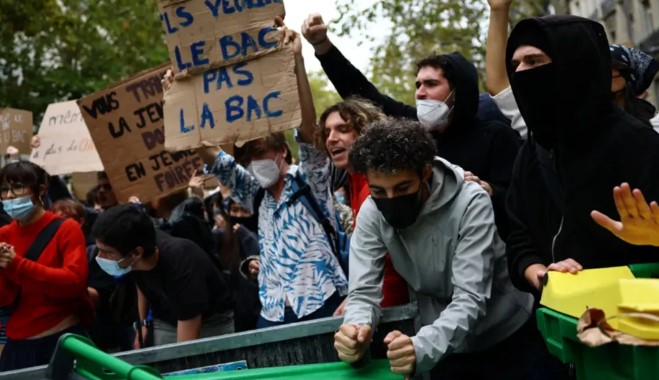
A student-led protest movement that began in France’s Paris region has rapidly expanded into a nationwide challenge over the state of public education, school funding and young people’s prospects.
Since late September, students have blockaded school entrances, walked out of classes and joined demonstrations in cities across the country. Hundreds of schools have been disrupted, while clashes involving protesters and police have resulted in injuries and thousands of arrests. By Thursday, authorities said more than 6,600 people had been arrested since the unrest began.
What are students demanding?
At the centre of the movement are complaints about teacher shortages, overcrowded classrooms and deteriorating school buildings.
Students say they are sometimes left without teachers when staff are absent because replacement teachers cannot be found. Poor classroom conditions have also become a major concern, particularly after periods of extreme heat.
The complaints extend beyond classrooms. Students have criticised long school days, complicated timetables and proposals involving mobile-phone restrictions. Some say they return home so late that there is little time left for homework, rest or family life.
Another major source of frustration is Parcoursup, the online system used to allocate places in higher education. Students argue that the process can feel opaque and adds pressure to an already competitive transition from secondary school to university.
Is France really underfunding its schools?
The picture is more complicated than the protest slogans suggest.
France spends relatively heavily on education compared with many other developed countries. The OECD’s 2026 data show that government spending per student in French general upper-secondary education was about $16,674 in 2023, substantially above the OECD average of $12,421. Overall government spending on education was also equivalent to 4.5% of GDP, compared with 4% across the OECD.
Teacher shortages, meanwhile, are not uniquely severe by international standards. The OECD estimates that the shortage of teachers in French public secondary education before or at the beginning of the 2023-24 school year was equivalent to 0.4% of teaching positions, one of the lowest rates among countries reporting comparable data.
That does not mean students’ complaints are unfounded. A shortage in a particular school or neighbourhood can have a major impact even when national statistics appear comparatively favourable.
Then why has the movement become so large?
The scale of the protests appears to reflect frustrations that go beyond individual school problems.
Students from disadvantaged areas have highlighted inequalities in educational opportunities, while others are concerned about their prospects after graduation. Overcrowded classrooms, missing teachers and ageing buildings have become symbols of a wider fear that public services are failing to meet their needs.
The government’s approach to the 2027 budget has added another layer of tension. Although the Education Ministry says the draft budget includes an additional €1.2 billion for education, protesters remain sceptical about whether the extra money will translate into noticeable improvements in schools.
The OECD has also noted a longer-term problem: France spends considerably on education, but student performance has deteriorated in some areas. Its 2026 economic survey said education spending was 4.7% of GDP in 2022, above the OECD average, while French 15-year-olds’ PISA results had fallen sharply.
Why are protests such a powerful tool in France?
There is also a distinctly French political tradition behind the movement.
Student demonstrations have repeatedly influenced government policy. Major protests helped force the withdrawal or modification of controversial education and employment measures in previous decades, including the 2006 youth employment law.
That history means young people in France know that occupying school entrances and taking their grievances to the streets can create political pressure far beyond the number of students directly involved.
The current movement has also gained support from teachers, trade unions and sections of the wider public.
Why has the unrest turned violent?
The escalation has become one of the most contentious aspects of the protests.
Authorities say some demonstrations have involved vandalism, fires and attacks, prompting police intervention. Protesters and their supporters, however, have accused police of using excessive force, particularly after teenagers were seriously injured during clashes.
The controversy intensified after a 15-year-old boy reportedly lost a hand during a confrontation involving a stun grenade. The government subsequently suspended the use of such grenades during the student protests and opened investigations into police conduct.
Prime Minister Sébastien Lecornu has called for dialogue while insisting that violence and attacks on public property cannot be tolerated. His government has also promised work on school buildings, teacher availability, school schedules and Parcoursup.
What happens next?
The government now faces the difficult task of addressing genuine concerns about schools while restoring order at hundreds of disrupted institutions.
The protests have already moved beyond a dispute over classroom conditions. They have become a broader expression of young people’s anxiety over educational inequality, public services and their future.
For now, students are continuing to mobilise, while the government says it will seek concrete responses before the end of October. Whether those measures are enough to calm the movement may depend on whether protesters see them as meaningful changes rather than promises.