

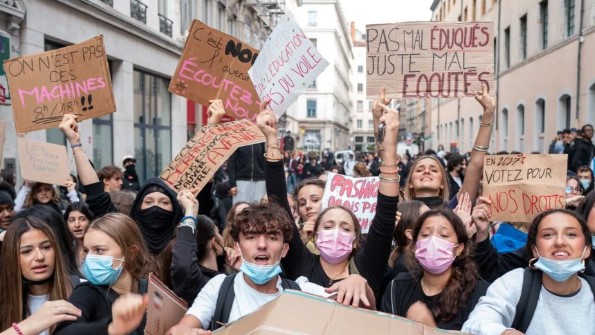
France has partially or completely closed up to 500 high schools as student protests over deteriorating education conditions have escalated into clashes with police, vandalism and mass arrests.
Education Minister Édouard Geffray said on Sunday that lessons would be “totally or partly suspended” at around 400 to 500 high schools on Monday because security conditions had not been met. The closures were also intended as a precaution ahead of larger demonstrations planned for Tuesday.
The protests, which began in the Paris region in late September, have spread to cities including Montpellier, Nantes, Marseille, Toulouse and Bordeaux. Students have raised concerns about teacher shortages, overcrowded classrooms, long school hours and deteriorating school buildings.
The unrest has also led to significant damage. Geffray said 24 schools had been burned or ransacked since the movement began. By Friday, 735 educational establishments had been affected in some way, although that figure included schools experiencing disruptions rather than closures.
The government has also reported a sharp increase in arrests. Interior Minister Laurent Nunez said 1,747 people were detained on Friday alone. More than 5,000 people had been arrested since the protests began, according to government figures, with most of those detained being teenagers.
Geffray said 78 education-sector employees had been injured since the protests began, while earlier reports indicated that dozens of school principals and teachers were among those hurt. More than 300 police officers and gendarmes have also been injured during the unrest.
The education minister has accused “ultra-violent fringe groups” of hijacking the student movement and putting teachers and pupils at risk. The government has also accused France’s hard-left La France Insoumise (LFI) party of helping fuel the unrest. LFI officials have rejected the allegation, accusing the government of promoting conspiracy theories about the protests.
Student groups, meanwhile, say their grievances remain unresolved and have called for further demonstrations on Tuesday.
“High school students are expecting concrete measures from this government, and so far we have not received them,” Ryad Rani, head of the USL high school union, said, according to AFP.
Prime Minister Sébastien Lecornu said Sunday that the government was taking additional steps to address the concerns of high school students and education workers.
The measures include keeping classes running, improving school infrastructure, better organizing students’ daily schedules and making the university admissions platform more transparent.
The government is also moving to accelerate its review of legislation that would make people responsible for paying for damage they cause to public or private property during acts of vandalism.
The protests come as the government faces pressure over its proposed 2027 budget and spending reductions. The unrest has therefore developed into a broader political challenge, although students’ initial demands have focused primarily on conditions inside schools.
More than 400 high schools remained partially or completely closed on Monday morning, according to the Education Ministry, as students continued protests ahead of Tuesday’s planned nationwide demonstrations.