
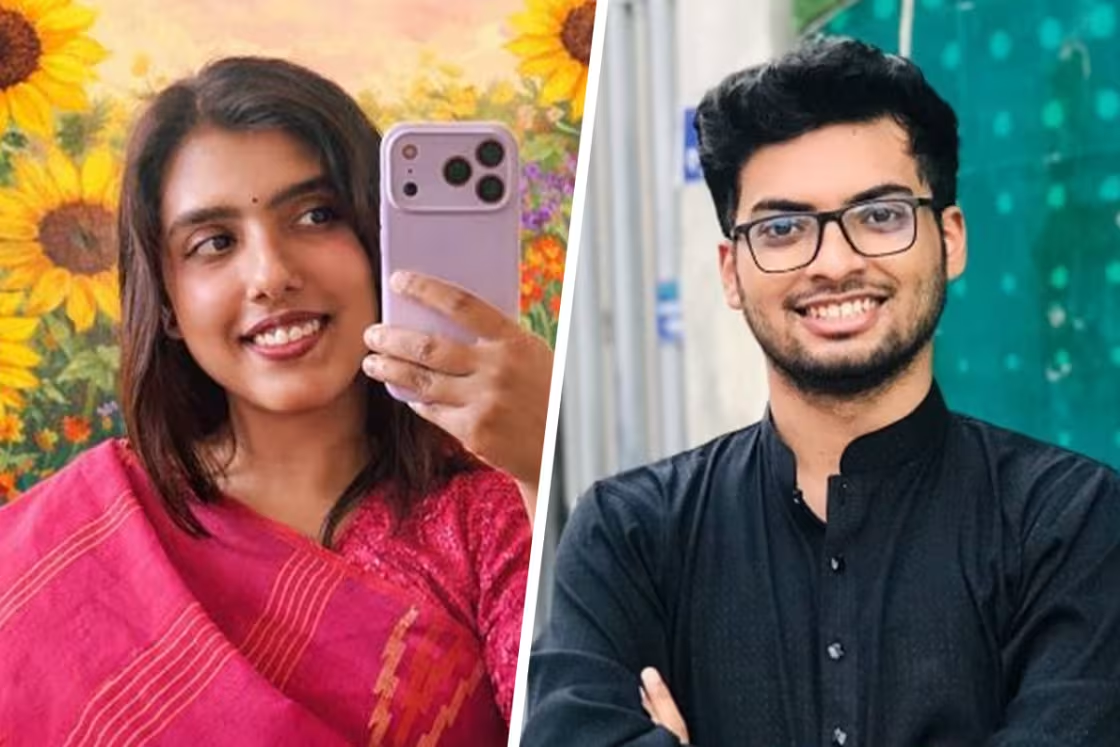
The disappearance of two Bangladeshi doctoral students from the University of South Florida—Jamil Limon and Nahida Sultana Brishti—has grown increasingly mysterious with each passing day. As time goes on, more questions are emerging than answers. The timing of their disappearance is also raising concerns. When viewed alongside reports of multiple scientists and officials in the United States dying or going missing under unclear circumstances in recent years, an uncomfortable question arises: Is this all a coincidence?
Family members and members of the Bangladeshi diaspora are united in their belief that neither Jamil nor Brishti would disappear voluntarily.
Jamil’s brother, Zubayer Ahmed, speaking from Bangladesh, said, “It has been five days. We are in unbearable pain. I cannot imagine, even in my wildest dreams, that he would disappear without informing anyone.” Brishti’s brother, Zahed Hasan Pranto, also made an emotional appeal: “Please stay safe and contact us.”
As investigators piece together the timeline, several troubling details have emerged. On Thursday at around 9:00 a.m., Jamil was last seen at his residence in the Avalon Heights apartment complex. He left with his phone and wallet, but his passport remained behind. His phone was last traced at around 11:00 a.m., still near his apartment.
That same day, at around 10:00 a.m., Brishti was last seen at the Natural and Environmental Sciences Building on campus. She left behind her laptop, iPad, and lunchbox, taking only her purse and phone. Her passport was also found later. Her phone signal was last detected at around 5:00 p.m. within the campus area.
Earlier that day, Brishti had spoken with her mother. The conversation was normal, and she mentioned plans to go shopping with a friend later. She did not mention Jamil.
Authorities have stated that surveillance footage has not revealed anything suspicious so far. Initially, police advised the families not to go to the media, as abduction was considered a possible early theory. However, after no concrete leads were found, the case was made public five days later—raising concerns among family members about the delay.
The Embassy of Bangladesh in Washington, D.C. has requested that the Federal Bureau of Investigation join the investigation. It has also been confirmed that neither individual is in the custody of U.S. Immigration and Customs Enforcement.
At the same time, another issue has been circulating within the Bangladeshi community. Reports claim that over the past three years, at least 11 individuals connected to highly sensitive U.S. research institutions—including Los Alamos National Laboratory, Jet Propulsion Laboratory, and MIT Plasma Science and Fusion Center—have either died
under unclear circumstances or gone missing. These individuals were reportedly involved in fields such as nuclear weapons, space research, fusion energy, and unidentified aerial phenomena research.
U.S. President Donald Trump has described the situation as “serious,” and the White House has indicated that multiple agencies, including the FBI, are reviewing the cases.
Jamil Limon is a PhD researcher in geography and environmental science and policy, while Brishti is pursuing a doctorate in chemical engineering. While these fields are not directly tied to national security, they can intersect with sensitive research areas. Some observers have noted similarities between their disappearance and other reported cases—such as leaving behind passports, sudden loss of contact, and no prior warning.
However, experts urge caution. Former national security official Frank Rose has pointed out that in large scientific institutions, isolated incidents can occur and do not necessarily indicate a pattern. Meanwhile, former FBI assistant director Chris Swecker has said that if
such cases are not random, they could suggest modern espionage—but no definitive link has been established.
The disappearance of Jamil and Brishti has sparked widespread concern among Bangladeshi communities across the United States and beyond. Their story has been widely shared on social media, with many raising questions about the pace of the investigation and whether there could be any connection to their academic work. At this point, however, there are
no confirmed answers.
Two things remain clear. First, the disappearance of Jamil and Brishti does not appear to be a typical case, and their families strongly believe they did not leave voluntarily. Second, recent reports of unusual incidents within the U.S. scientific community have added to the
sense of unease. Whether there is any connection between these developments remains a matter for investigators.
Anyone with information about Jamil Limon or Nahida Sultana Brishti is urged to contact USF Police at 813-974-2628.